

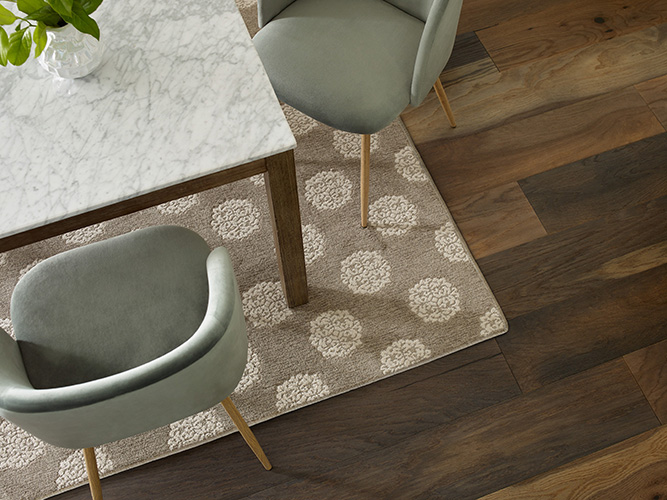
You walk into a showroom, spot a rug you love, and flip over the corner tag. "Hand-knotted." "Hand-tufted." "Machine-made." If the distinctions feel blurry, you are not alone. Westchester homeowners shopping for area rugs often encounter all three construction types in a single visit — and each one carries real implications for longevity, texture, and value. Understanding what separates them turns a confusing label into a confident decision.
Hand-Knotted: The Artisan's Method
A hand-knotted rug begins with a loom. Individual knots are tied by hand onto the warp threads, row after painstaking row — a single 8-by-10-foot piece can take months to complete. The result is a dense, durable textile where the pattern runs through the entire structure, not just across the surface.
Because each knot is tied individually, these rugs achieve a level of detail and clarity no machine can replicate. They are almost always crafted from wool, sometimes blended with silk for sheen. Wool's natural resilience means the fibers spring back after compression, resisting matting in high-traffic areas for decades. Hand-knotted rugs frequently feature the intricate floral medallions and geometric borders associated with traditional oriental designs — the kind that feel at home anchoring a formal living room in a Mohegan Lake colonial.
The tradeoff: hand-knotted rugs command the highest price in the market. What you pay for is measured in years — these pieces routinely last 30, 50, or even 100 years with proper care.
Hand-Tufted: A Practical Middle Ground
Hand-tufted rugs take a different path to a handmade look. Instead of knotting, the artisan uses a tufting gun to punch yarn through a fabric backing stretched on a frame. The pile is then secured with a latex adhesive and a secondary canvas backing. The process takes hours or days rather than months.
The visual results can closely mimic hand-knotted construction at a significantly lower cost. The pile is plush, the patterns elaborate, and the color range broad. For homeowners furnishing a guest bedroom or updating a dining room on a timeline, hand-tufted rugs hit a sweet spot between aesthetics and accessibility.
Where they differ is longevity. The latex adhesive holding the fibers in place can degrade over 10 to 15 years, especially in humid conditions — something Westchester's summer months can accelerate. Hand-tufted rugs also tend to shed more than knotted ones. They are a sound investment for moderate-traffic spaces but less suited to entryways or family rooms that see daily wear.
Machine-Made: Precision at Scale
Machine-made rugs are woven on power looms, producing consistent, repeatable patterns at high speed. Modern loom technology is remarkably sophisticated — some machines can simulate the irregularity of hand-knotting to the untrained eye.
The advantages are price, speed, and durability. These rugs often use synthetic fibers like polypropylene or polyester, which resist stains and fading. They work well in basements, playrooms, or under dining tables where spills are a regular occurrence. The uniformity of machine construction also makes them easier to clean and far lighter to move than their hand-knotted counterparts.
What machine-made rugs lack is the one-of-a-kind character and investment-grade durability that handmade construction provides. The fibers sit on the surface rather than running through the rug's structure, so patterns can wear thin over time in high-traffic lanes.
Matching Construction to Your Life
No single method wins across the board. The right choice depends on where the rug will live and how it will be used. A hand-knotted wool rug in the formal living room becomes an heirloom. A hand-tufted piece in the master bedroom delivers warmth and pattern without the heirloom price tag. A machine-made rug in the mudroom handles wet boots and paw prints without drama.
Our area rug buying guide walks through room-by-room considerations, sizing, and materials in more depth. And since every home presents its own set of constraints — light, traffic patterns, existing flooring — sometimes the fastest path to clarity is seeing the options in person.
Visit Allen Carpet & Home at our Mohegan Lake or Mount Kisco showroom, or schedule your free estimate online. Our team can help you assess construction types, materials, and sizing so you leave with a rug that belongs in your home, not just in the showroom.

