
You've just closed on a 1920s colonial in Mount Kisco with good bones and original hardwood that has seen better days. The foyer greets visitors with a long, straight run of narrow oak — serviceable, but not memorable. You want the entry to feel intentional. Curated. A floor that stops people mid-sentence.
That's exactly where herringbone and chevron patterns earn their reputation.
Two Patterns, One Big Impact
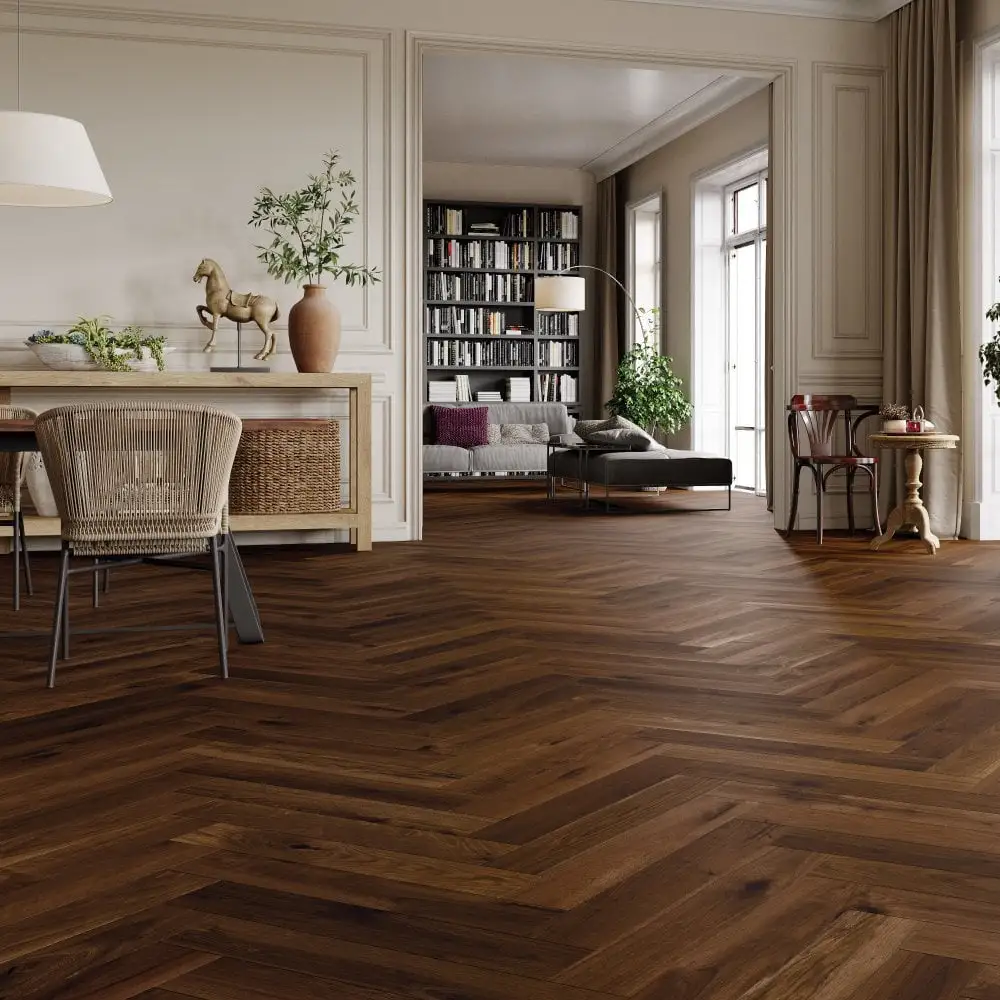
Herringbone and chevron both create a zigzag effect underfoot, but they achieve it differently. Herringbone uses rectangular planks laid perpendicular to one another, the end of one board butting against the side of the next to form a broken, staggered V. The result feels woven — like tweed translated into wood. Chevron takes a cleaner approach: each plank gets cut at a precise angle so the ends meet in a continuous, unbroken point. Where herringbone reads as textured movement, chevron delivers a crisp, architectural line.
Both patterns demand more material and labor than a standard plank run. The payoff is a floor that transforms a room from background to focal point before you've placed a single piece of furniture.
Rooms That Reward the Investment
Patterned hardwood works hardest in spaces where you want to define the experience of entering or gathering. A foyer with a chevron floor in white oak telegraphs restraint and precision. A dining room in a Mohegan Lake colonial benefits from the quieter complexity of herringbone — formal enough for holiday dinners without feeling like a museum. Hallways and galleries, often neglected in renovation plans, gain direction and rhythm when the floor itself pulls the eye forward.
One caveat: these layouts read best in rooms with clean sightlines. An overly compartmentalized space fractures the pattern and dilutes the effect. If your floor plan breaks into multiple small zones, our interior design team can help you assess sightlines and determine where a patterned layout will deliver the most impact.
What You Need to Know Before Committing
Patterned installations amplify every variable that matters in hardwood selection. Wood expands and contracts with seasonal humidity — and Westchester's climate, with its dry winters and moisture-heavy summers, pushes those swings further than most regions. When planks shift even slightly, a herringbone or chevron layout shows it more readily than a straight run. For this reason, engineered hardwood often makes the smarter choice. Its cross-ply construction resists dimensional movement better than solid wood, keeping those tight angles locked in place through the seasons.
Installation expertise matters here more than for any other hardwood layout. The subfloor must be dead-level. Each miter cut for chevron must be exact. The layout has to be mapped from the room's true center, not its walls — because few older Westchester homes have perfectly square rooms. For a deeper look at what to evaluate before starting a project, our hardwood buying guide walks through species, construction, and budget considerations.
Cost runs higher than a standard plank floor — typically 15 to 30 percent more — due to the additional material waste from angle cuts and the specialized labor required. If you're weighing the expense, consider that these floors rarely get replaced. They're permanent architectural features, not disposable design choices.
Making the Pattern Work With the Rest of the Room
A herringbone or chevron floor is already doing a lot visually, so surrounding elements benefit from restraint. Solid-colored area rugs let the pattern breathe around the edges rather than competing with it. Furniture with clean profiles — tapered legs, uncluttered silhouettes — sits lightly on the patterned surface without obscuring it.
If your home has a staircase visible from the patterned floor, custom stair runners can bridge the transition with a complementary textile that picks up a tone from the wood without mimicking the geometry. The goal is cohesion, not a match.
For homeowners curious about the full range of pattern, texture, and species combinations available, our showrooms stock engineered hardwood samples that let you see how grain and finish interact with these angular layouts in natural light.
Visit our Mount Kisco showroom — one of three Allen Carpet & Home locations across Westchester County — to walk on sample layouts and talk through your project with someone who understands older homes and exacting standards. Schedule your free estimate and we'll bring samples directly to your space so you can see how the light hits the angles in the room where they'll actually live.

