

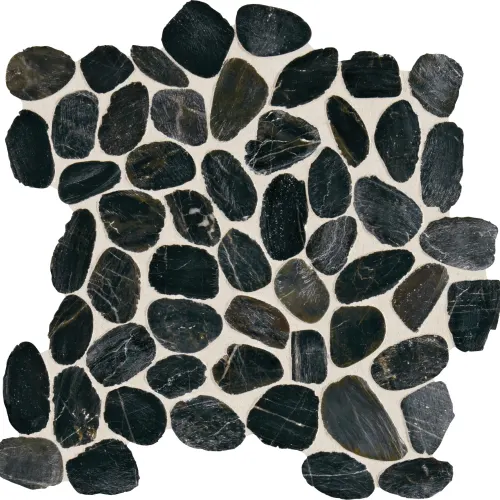
Dense, low-absorption natural stone like granite and quartzite survives a Westchester winter outdoors; soft, porous stone falls apart. The reason is water. Stone that soaks up water freezes from the inside and breaks, and our winters freeze and thaw that trapped water over and over. So the single most useful thing to know before you buy stone for a patio, walkway, or driveway apron is how much water the stone drinks. The numbers below separate a patio that lasts decades from one that spalls in five winters, along with the slip rating to ask for outdoors and where a covered porch changes the math.
Which Natural Stones Survive a Westchester Winter Outdoors?
Dense stones with very low water absorption survive a Westchester winter outdoors; soft, porous stone does not. Granite is the workhorse: water absorption for most granite runs from 0.05% to 0.4% of its weight, low enough that freeze damage almost never gets started, per a stone-industry technical guide on cold-climate performance. Quartzite behaves the same way for the same reason. On the other end sit limestone, travertine, and the softer marbles, the category that flakes and pits first outdoors; limestone alone can absorb anywhere from 3% to 12% of its weight in water. That gap in absorption is the whole story. A stone that holds a lot of water has a lot of water to freeze, and every hard freeze is another chance for it to crack.
Why Freezing Water Cracks Porous Stone
Freezing water cracks porous stone because water expands as it turns to ice, and open pores give that ice room to do damage. Water grows about 9% in volume when it freezes, a figure the U.S. Geological Survey, the federal science agency that studies water, puts at the heart of why ice floats and why pipes burst. Picture that happening inside a paver. Rain and snowmelt seep into the tiny pores of the stone, the temperature drops below freezing overnight, and the ice pushes outward on the pore walls with real force. One cold night does nothing you can see. But over many winters the micro-cracks spread, link up, and finally show as surface flaking, pitting, and spalling — the crumbly, shedding surface you find on an old limestone step. Westchester sits in USDA hardiness zone 7a, which marks an average annual low of 0°F to 5°F; the coldest nights reach around 0°F and January averages near 29°F, so outdoor stone here freezes and thaws for months.
Water Absorption by Stone Type: The Numbers That Matter
Water absorption is measured by a standard test, and the resulting percentage is the best single predictor of how a stone handles the outdoors. The test is ASTM C97, written by ASTM International, the standards body whose material specifications architects and fabricators write into their contracts; a lab dries stone samples, soaks them in water for 48 hours, then weighs them again to see how much they took on. ASTM also publishes a separate specification for each stone type, and each one sets a ceiling on absorption. The table below pulls those ceilings together with the freeze-thaw verdict they imply. Lower is better outdoors, and the jump from granite to limestone is not a small one.
| Stone | ASTM specification | Water absorption ceiling | Freeze-thaw fit outdoors |
|---|---|---|---|
| Granite | ASTM C615 | 0.40% by weight | Excellent, most exposed uses |
| Quartzite | ASTM C616 | Very low | Excellent |
| Slate | ASTM C629 | Low | Good for most slates |
| Marble | ASTM C503 | 0.20% by weight | Limited; softer types pit |
| Travertine | ASTM C1527 | High, many holes | Covered spaces only |
| Limestone | ASTM C568 | 3% to 12% by weight | Poor when exposed |
Slip Resistance Outdoors: The DCOF Number to Ask For
Outdoor stone needs a higher slip rating than an indoor floor, and the number to ask for is a wet DCOF of 0.55. DCOF stands for dynamic coefficient of friction, the grip a floor keeps while your foot is already sliding across it, measured wet under the ANSI A326.3 hard-surface standard from the Tile Council of North America (TCNA), the trade group that writes North America's tile installation and testing rules. Indoors, a level floor that gets wet needs a wet DCOF of at least 0.42. The 2022 version of the standard set tougher marks for tougher spots: 0.50 for wet barefoot areas, and 0.55 for exterior wet areas and for floors that see oil or grease. A patio lives in that top category. Ask for the wet DCOF on the spec sheet, and lean toward a honed, sandblasted, or flamed finish over a polish, because a polished surface that looks stunning dry turns into a skating rink under rain and frost.
Sealing and De-Icing: What Actually Protects Outdoor Stone
Sealing helps outdoor stone resist stains, but sealing is no cure for a stone that soaks up water. An impregnating sealer slows how fast water enters the pores, which buys time against oil and rust marks. It doesn't make a porous limestone into a freeze-proof one; if the stone can saturate, a sealer worn thin by weather and traffic still lets water in, and then the freeze does its work. Choosing a dense, low-absorption stone up front is the protection that lasts. Winter care matters just as much. Keep rock salt and ordinary de-icers off stone: they lower the freezing point of water and, as one stone-restoration reference puts it, increase the number of effective freeze-thaw cycles the stone goes through each winter. Reach for sand for traction, or a de-icer labeled safe for natural stone, and clear snow with a plastic shovel.
Covered Porches vs Fully Exposed Patios
Covered outdoor spaces open the door to stones that would fail on an open patio. Freeze-thaw damage needs the stone to be wet when it freezes, so a stone kept under a porch roof, out of the rain and snow, faces far less risk than the same stone on an open walkway that soaks up every storm. On a covered porch or a screened room, a honed marble or a travertine can work where it would spall in the open. A fully exposed patio, driveway apron, or pool deck in Mohegan Lake or Putnam Valley, both far enough north to take the county's coldest nights, wants the dense end of the table: granite, quartzite, or a hard bluestone. When you tell us where the stone will live, our installers set a proper base with slope and drainage so water sheds instead of pooling and freezing under the surface.
When Porcelain Pavers Make More Sense Than Stone
Porcelain pavers are worth a look when you want a stone appearance with almost no absorption to worry about. Porcelain is fired dense enough that it barely takes on water, the exact property that makes a paver shrug off freeze-thaw. The ASTM freeze-thaw test for tile (ASTM C1026) exists precisely to sort out which fired tiles hold up to repeated freezing outdoors. A thick outdoor porcelain paver can mimic bluestone or travertine and still land in the low-absorption camp. It won't have the depth and variation of real stone, and that's a fair trade-off to weigh. You can compare the porcelain in our tile catalog against the natural stone selection side by side, which is the easiest way to feel the difference in your hand.
Questions We Get About Outdoor Stone in Westchester
Can I put marble or travertine on an open patio here?
Marble and travertine belong under cover in this climate rather than on a fully exposed patio. Both are more porous and softer than granite, so out in the open they pit, etch, and spall after a few Westchester freeze-thaw winters. Under a porch roof or in a screened room, where the stone stays dry, either one can be a beautiful floor. Out in the weather, choose granite, quartzite, or a hard bluestone.
Does sealing let me use any stone outdoors?
Sealing doesn't turn a porous stone into an outdoor stone. A sealer slows water from entering and helps with stains, but it wears with weather and traffic, and a stone that can saturate will freeze and break in the end anyway. Match the stone to the exposure first, then seal it as upkeep. That order is what keeps a patio intact.
What about a stone driveway apron or walkway?
A driveway apron or walkway takes the harshest exposure a home has, so it calls for the densest stone you can get. Granite setts and hard quartzite handle traffic, standing water, and repeated freezing far better than any soft stone. Keep de-icing salt off it, use sand for grip, and give it a base that drains. Those three habits add years.
Planning an Outdoor Stone Project in Westchester
The outdoor stone that lasts in Westchester is the dense, low-absorption kind, set on a base that drains and finished with enough texture to stay safe when wet. Start with the exposure, covered or open, foot traffic or driveway, and let that decide the stone before you fall for a color. We sell natural stone and porcelain that hold up here, our crews handle outdoor installations, and we'll tell you honestly when a stone you love belongs on a covered porch instead of an open patio. When you're ready to price it out, request a free in-home estimate and we'll look at the space, talk through the stones, and measure what you need.

