

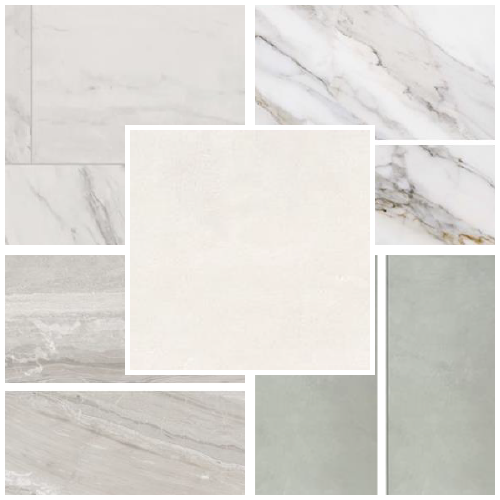
Porcelain and ceramic tile are the same fired-clay family, and the split between them comes down to one measured number: how much water the tile drinks. Porcelain is the dense half, defined as tile that soaks up 0.5% of its weight in water or less. Ceramic that isn't porcelain absorbs more, sometimes a lot more. That one property, plus how hard the surface wears and how it grips when wet, is what should decide which tile goes in your entry, your shower, or your kitchen. We sell both and our crews install both, so the honest answer isn't "always porcelain." It's that each one wins in different rooms, and the ratings tell you where.
What Actually Separates Porcelain From Ceramic Tile?
Porcelain tile is separated from ordinary ceramic by water absorption, a number that comes from a lab soak test, and color or price has nothing to do with it. Under ANSI A137.1, the American National Standard for ceramic tile published by the Tile Council of North America (TCNA), the industry lab that writes and runs these tests, a tile only earns the word porcelain when it absorbs 0.5% of its weight in water or less, measured by the ASTM C373 soak method. Everything above that line is non-porcelain ceramic. Why does porcelain drink so little? Density. The classic porcelain body is fired to roughly 1200 to 1400 degrees Celsius, hot enough to vitrify the clay into a tight, glassy mass. A denser tile is harder, stronger, and far less bothered by water. Every room decision below follows from that.
Porcelain vs. Ceramic Tile, By the Numbers
Set porcelain and ceramic side by side and the ratings line up cleanly, and the table below pulls each figure from the primary standards instead of sales copy. The two international reference points are ANSI A137.1 in the United States and ISO 13006 from the International Organization for Standardization (ISO), the specification that sorts tile into water-absorption groups. On that ISO 13006 scale, porcelain is Group BIa at 0.5% or less, and ordinary ceramic climbs from there: up to 3%, then up to 6%, then up to 10%, and past 10% for the thirstiest wall tile. Read the table as a starting point, then match it to the room.
Rating | Porcelain | Ceramic (non-porcelain) |
|---|---|---|
Water absorption | 0.5% or less | More than 0.5% |
ISO 13006 group | Group BIa | BIb through BIII |
Floor breaking strength | Clears the 250-pound minimum | Varies; check the spec |
Freeze-thaw outdoors | Suited to it | Keep indoors, heated |
Wear class range | Up to Class 5 | Often Class 0 to 3 |
Where it belongs | Floors, wet, outdoor | Walls, light-traffic floors |
Cost is the one column the standards don't set, and it's where ceramic earns its keep. Porcelain generally runs more per square foot than a comparable ceramic, and it costs a bit more to install because a denser tile is slower to score and snap. You're paying for that low absorption number and the strength that rides along with it. In a room that never sees water or heavy traffic, the porcelain premium buys performance you won't use. On a shower floor or by the back door, skipping it is a false economy. The rest of this guide is about telling those rooms apart.
Which Tile Belongs in a Westchester Entry, Mudroom, or Unheated Room?
In a Westchester winter, porcelain belongs in the entry, the mudroom, and any unheated or outdoor space, and it isn't a close call. Three things gang up on a floor near the door here. Water that soaks into a porous tile and then freezes will expand and can pop the surface or break the bond, which is exactly what the ASTM C1026 freeze-thaw test checks for, and a near-zero absorption tile like porcelain shrugs it off. Road salt tracks in all winter and sits in the grout and the pores. Then there's grit, the quiet one. Tracked-in sand is mostly quartz, and quartz sits at 7 on the 10-point Mohs scale that mineralogists use to rank scratch hardness, so a softer glaze dulls and scratches over a single season. For scale, a steel knife blade is only about 5 to 6.5, which means the sand underfoot is harder than the knife in your drawer. A through-body porcelain, colored all the way through, hides the wear a glaze would show. For a converted, unheated entry on an older Mohegan Lake cottage, that's the line between a floor that lasts and one you redo.
Bathrooms, Showers, and Kitchens: Matching the Tile to the Job
Bathrooms, showers, and kitchens each ask a different question of a tile, so the right material can change from the wall to the floor to the shower pan. On a bathroom or kitchen wall, wear barely matters: a light ceramic wall tile is fine, and a wall-only tile carries a PEI Class 0 rating, PEI being the abrasion scale (named for the old Porcelain Enamel Institute) that the ISO 10545-7 test now sets. A shower floor is the opposite job. It's wet by definition, so you want a low-absorption tile with enough grip. The grip number is DCOF, the dynamic coefficient of friction from the ANSI A326.3 test, and TCNA sets 0.42 as the wet floor minimum for level interior tile walked on when wet. Below 0.42, a wet floor is a real slip risk. Kitchen floors take dropped pans and long standing, so pick a floor-rated tile at PEI Class 3 or higher that clears the 250-pound breaking-strength minimum ANSI sets for floor tile. Our broad look at tile, stone, and glass tile for kitchens and baths walks the same rooms if you're planning a full remodel.
When Ceramic Tile Is the Smarter Choice
Ceramic tile is the smarter buy on walls, on backsplashes, and on dry floors that see light traffic, and there's no prize for over-building a powder-room wall with porcelain. Non-porcelain ceramic is softer, which sounds like a knock but cuts both ways. It's easier and cheaper for our installers to score, snap, and shape around outlets and corners, so intricate wall work often goes faster and costs less in ceramic. Glazed ceramic also comes in glazes and colors that porcelain lines don't always match. The catch is knowing the line. Ceramic's higher absorption and lower wear class are fine on a dining-room wall and wrong on a shower floor. If the room stays dry, stays warm, and doesn't take a beating, ceramic does the job for less money. You can compare finishes across the ceramic and porcelain tile we stock before you commit to either.
Questions We Hear About Porcelain and Ceramic Tile
Is porcelain tile always better than ceramic?
Porcelain isn't always the better choice; it wins where water, wear, or cold are in play, and ceramic is the better value everywhere else. On a dry, low-traffic wall, a ceramic tile does the same visual job for less and cuts more easily. Match the tile to the room and you rarely overpay.
How can I tell if a tile is really porcelain?
A real porcelain tile is proven by its water absorption, so check the spec sheet for the 0.5% figure or look for the Porcelain Tile Certification Agency (PTCA) mark, the third-party stamp TCNA backs. Labels alone can be loose, since ISO hasn't trademarked the word porcelain, but the tested absorption number doesn't lie. A stricter grade called technical porcelain goes under 0.1%, though for a home floor the 0.5% line is the one that matters.
Does porcelain crack more easily because it's harder?
Porcelain doesn't crack more easily; harder isn't the same as brittle here. Floor tile has to clear the 250-pound breaking-strength minimum ANSI sets, tested the way ASTM C648 lays out, and porcelain clears it comfortably. What actually cracks tile is a bad subfloor, so our crews prep and level the subfloor before a single tile goes down.
Can I use ceramic tile on a bathroom floor?
Ceramic tile can go on a bathroom floor as long as it's floor-rated and grippy enough, which means a PEI class of 2 or higher and a wet DCOF of 0.42 or above. A glazed wall tile rated Class 0 will be slick and will wear, so keep that one on the wall.
Choosing the Right Tile for Each Room in Your Home
The rule is short. Choose porcelain when the floor gets wet, cold, or hard use: entries, mudrooms, bathrooms, shower floors, kitchens, and anything outdoors, where its 0.5% absorption, freeze-thaw resistance, and higher wear class all earn their cost. Choose ceramic when the surface stays dry and lightly used: most walls, backsplashes, and quiet-room floors, where you save money and gain easier cuts. When you're weighing a specific room, our design team can pull samples across all three showrooms, and when you're ready to price it for your house, request a free in-home estimate and our installers will measure the rooms and talk through the trade-offs with you.

