
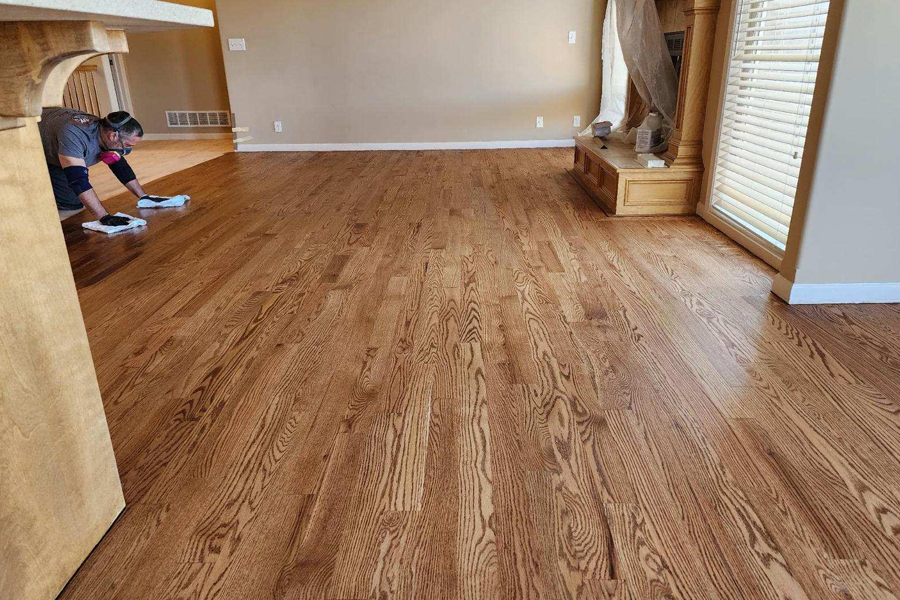
You found the house. A 1920s colonial in Yonkers with original millwork, a gracious front porch, and hardwood floors that have seen better decades. The oak underfoot has character — maybe too much. Cupped planks near the windows, gaps you can slide a quarter through, and a patina that reads more "neglected" than "vintage."
Now you're standing in the showroom, staring at samples, and someone tells you that ripping out those old floors and nailing down solid hardwood might not be your best move. That engineered — the stuff your contractor uncle still calls "fake wood" — is actually the smarter play for a house like yours. Here is why that advice holds up.
Older Subfloors Were Not Built for Modern Solid Hardwood
Most homes built before 1960 sit on subfloors that have shifted, settled, and developed personality. Plank subfloors have gaps. Joists have sagged. Rooms that were "close enough" in 1923 are not within the flatness tolerance that modern solid hardwood demands.
Engineered hardwood handles this reality far better. Its cross-ply construction — layers of real wood bonded in alternating grain directions — gives it dimensional stability that solid wood simply cannot match. A solid plank expands and contracts as one piece, pulling against fasteners and neighboring boards with every humidity shift. An engineered board's layered structure resists that movement at the molecular level. For homes where the subfloor tells a century-long story of settling, engineered hardwood eliminates the callbacks that solid installs often invite.
How Westchester's Seasonal Swings Work Against Solid Wood
Westchester County gets the full spectrum. Humid summers that push moisture into every pore of a home. Dry winters where forced-air heating pulls it right back out. A solid oak floor in a Mohegan Lake split-level might swell in August and shrink in February, opening gaps along the baseboards that no amount of wood filler will truly fix.
The engineered advantage here is not subtle — it is structural. Because each layer's grain runs perpendicular to the one beside it, the board has almost no room to expand width-wise. Length-wise movement is negligible in both products, but the width stability is what saves a floor from gapping. For anyone weighing options, reviewing the hardwood buying guide walks through the construction differences in detail so you can see exactly what you are paying for beneath the wear layer.
Installation Realities That Solid Hardwood Ignores
Older homes rarely cooperate with installation schedules. Door casings sit at odd heights. Radiators occupy corners where flooring needs to die into trim. Transitions between rooms never line up. Solid hardwood requires nailing through the tongue into a wood subfloor — full stop. If your subfloor is concrete, or if radiant heat runs beneath it, solid is out.
Engineered gives you options. It can be glued directly to concrete. It can be floated over a sound-control underlayment — a genuine advantage in co-ops and condos where building boards enforce noise transmission standards. The thinner profile also clears existing door swings and baseboard heights that a ¾-inch solid plank would force you to re-trim. Before committing to any product, reviewing an installation preparation guide helps you understand what your particular home will actually require.
The Wear Layer Is What Matters
A common objection: you cannot refinish engineered hardwood. That was true twenty years ago. Today's premium engineered planks carry wear layers of 3mm to 6mm — thick enough to sand and refinish at least once, sometimes twice, depending on the depth. And with modern factory finishes that include aluminum oxide and UV-cured urethanes, the initial coating outlasts what site-finished solid floors receive.
So the real question is not whether engineered can be refinished. It is whether the stability, installation flexibility, and moisture resistance it brings to an older home outweigh the one extra sanding cycle you might get from solid. In most pre-war houses around Mount Kisco and across the county, the answer leans decisively toward engineered.
Seeing the Difference for Yourself
Choosing flooring for an older home means balancing what the structure will accept with what you want underfoot. Engineered hardwood closes the gap between those two things more gracefully than any other product category. At Allen Carpet & Home, you can compare species, finishes, and construction types side by side — and talk through your home's specific quirks with someone who has seen them before. Visit our Mohegan Lake, Yonkers, or Mount Kisco showroom to explore samples in person, or schedule your free estimate and have us take measurements at your home.

