

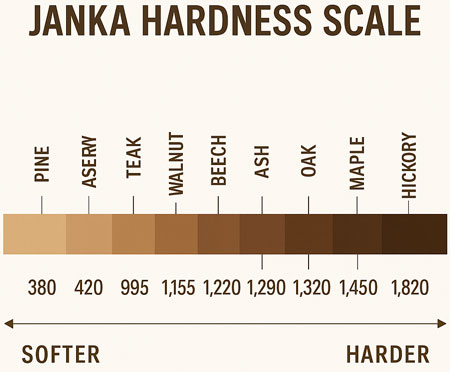
If you've spent any time researching hardwood floors, you've probably encountered the Janka hardness scale and wondered what those numbers actually mean once the samples are off the table and real life moves in. A Mohegan Lake family with two kids, a golden retriever, and a dining room that doubles as homework central doesn't need an abstract rating. They need to know which floor survives the weekend.
The good news is that the Janka scale, stripped of its technical veneer, is actually a remarkably practical tool. You just have to translate it into the language of dropped cast-iron pans, chair legs scraping backward, and wet boots hitting the entryway in February.
What the Janka Scale Actually Measures
The test itself is refreshingly straightforward. A steel ball 0.444 inches in diameter gets pressed into a wood plank until it reaches half its depth. The pounds of force required to do that — that's the Janka rating.
Red oak sits at 1290 and serves as the industry's baseline. If a species rates higher, it's harder than oak; lower, softer. Northern hard maple lands around 1450. Hickory, the hardest domestic species commonly used for flooring, reaches 1820. Black walnut, by contrast, comes in at roughly 1010 — elegant but notably softer. On the exotic end, Brazilian cherry (Jatoba) can exceed 2300, though most Westchester homeowners gravitate toward domestic species for their warmth and compatibility with the region's architectural character.
The key insight is that the scale doesn't rank floors from "bad" to "good." It helps you align a wood's physical tolerance with the specific abuse each room dishes out. Our hardwood buying guide walks through how hardness fits into the broader decision — from species selection to finish types.
Matching Hardness to How You Actually Live
High-traffic chaos zones demand the top of the scale. Entryways that catch road salt from Westchester winters, kitchens where stools get dragged across the floor a dozen times a day, hallways that serve as indoor dog highways — these spaces reward the highest ratings you can afford. Hickory hardwood at 1820 takes dropped toys, tumbling backpacks, and claw scrabbles with almost no visible complaint. Its pronounced grain variation also helps disguise whatever minor wear does accumulate.
The balanced middle covers most of a home's square footage. Living rooms, dining rooms, and bedrooms see regular foot traffic but not the concentrated punishment of an entryway. Oak flooring — red at 1290, white at 1360 — has anchored American homes for generations for exactly this reason. It's tough enough for daily life without feeling industrial. Walk through any 1920s colonial in lower Westchester and the floors underfoot are almost certainly oak, still performing after a century.
Lower-traffic elegance gives softer species room to shine. A formal living room where shoes come off and footfall is occasional can showcase walnut hardwood beautifully. At around 1010 on the Janka scale, walnut won't shrug off heavy abuse the way hickory does, but in a quiet, adult-oriented space it delivers a depth and richness that harder woods rarely match.
Hardness Is Only Part of the Story
Texture choices change how a floor wears as much as the Janka rating does. A wire-brushed or hand-scraped surface naturally obscures the small dents and scratches that would telegraph on a smooth, glossy finish. Two families with the same hickory floor can have dramatically different experiences depending on whether they chose a matte, textured plank or a polished one.
Construction matters, too. Engineered hardwood, built with a cross-ply core, handles the humidity swings between Westchester's dry winters and muggy summers more dimensionally stable than solid wood — regardless of species hardness. And the factory-applied finish often determines day-to-day scratch resistance more than the wood itself. An aluminum oxide finish on a softer species can outperform a basic polyurethane on a harder one.
The Janka number is a starting point, not the whole conversation. It tells you how the raw wood responds to pressure. It doesn't tell you how the floor will look after five years of family life — that depends on texture, finish, construction, and how you maintain it.
Hardwood flooring is a long-term commitment, and getting the species right for your lifestyle matters more than chasing the highest number on a chart. Visit Allen Carpet & Home at any of our three Westchester showrooms to walk samples side by side and feel the difference yourself — or schedule a free in-home estimate and we'll bring the options to your door.

