
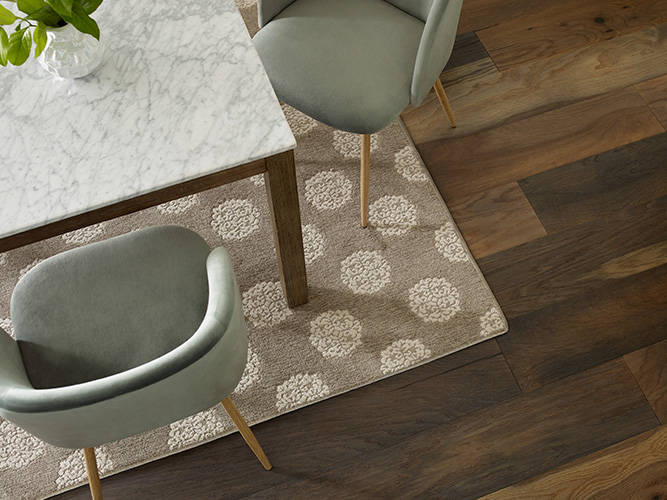
A family in Mohegan Lake bought a beautiful area rug for their living room two years ago. It anchored the space perfectly — warm colors, the right size, a pattern that pulled the room together. Today it looks tired. The pile is matted flat where the sofa legs rested. The traffic path between the couch and the kitchen door has worn thin. They assumed all rugs fade at roughly the same rate. They don't. The single biggest factor in how many years you get from an area rug isn't the price tag or the brand name. It's the fiber.
Wool: The Long-Game Fiber
Wool has been the standard for heirloom-quality rugs for centuries, and the reasons are built into the fiber itself. Each wool strand has a natural crimp — a microscopic wave structure that acts like a spring. When you compress wool, it pushes back. That resilience is why a well-made wool rug can handle decades of foot traffic and still spring back after furniture is rearranged.
Wool also carries a thin coating of lanolin, the same natural oil that makes sheep's fleece water-repellent. This gives wool rugs a built-in defense against spills, though it is not a substitute for blotting up liquid quickly. The fiber accepts dye deeply and evenly, so colors stay rich far longer than they do on synthetics. The downside is price — wool area rugs command a premium upfront. But spread that cost over twenty or thirty years and the math shifts decisively in wool's favor. For anyone who wants a deeper look at how different fibers and construction methods affect performance, our overview of area rug materials and backing types walks through the factors that separate a decade rug from a two-year rug.
Synthetics: A Spectrum, Not a Monolith
Treating all synthetic rugs as interchangeable is the fastest route to a short-lived purchase. Nylon, polyester, and polypropylene each behave differently under daily use.
Nylon is the performance workhorse. Like wool, it has strong resilience — it bounces back from furniture dents and foot traffic. It handles high-moisture areas better than wool, which makes it a practical pick for basements and entryways. In a busy Yonkers condo where the front door opens directly into the living space, nylon holds its own.
Polyester excels at color. It takes dye brilliantly and resists fading even in sun-drenched rooms. The trade-off is resilience — polyester fibers do not spring back the way nylon or wool do, so heavy furniture leaves lasting impressions. It is a better fit for low-traffic bedrooms and formal sitting rooms than for hallways and family rooms.
Polypropylene (also labeled olefin) is the budget entry point. It is inherently moisture-resistant and stain-resistant, so it works in a finished basement or a kids' play area. The lifespan is shorter — polypropylene fibers flatten under sustained traffic and do not recover.
The right synthetic in the wrong spot still wears out fast. A basic care routine matched to the fiber extends the clock on any rug, but no amount of vacuuming reverses a fiber mismatch.
Traffic Patterns Write the Final Chapter
Fiber choice and placement are two halves of the same equation. A thick wool rug in a formal Mount Kisco dining room used twice a year on holidays will outlast the homeowner. That same wool rug in a Mohegan Lake mudroom where kids and a Labrador retriever track in winter salt and spring mud? Its lifespan shrinks dramatically — not because the wool failed, but because the application was wrong from the start.
High-traffic zones — hallways, stair landings, entryways, the path between the kitchen and the family room — demand fibers with strong resilience and dense construction. Low-traffic spaces like guest rooms and formal living rooms give you more freedom to prioritize color and softness over outright toughness. A rug that sees direct sunlight for six hours a day will test the fade resistance of any fiber. Matching the material to the room's reality matters more than matching it to a budget spreadsheet.
The fiber inside your rug is the closest thing to a warranty on its future. Wool rewards the investment with decades of service. Nylon delivers reliable durability at a lower price. Polyester and polypropylene have their roles — but only in the right rooms. At Allen Carpet & Home, our team can walk you through the differences in person so you leave with a rug built for the life your household actually lives. Stop by our showrooms in Mohegan Lake, Yonkers, or Mount Kisco, or schedule a free estimate to get expert guidance before you buy.

