

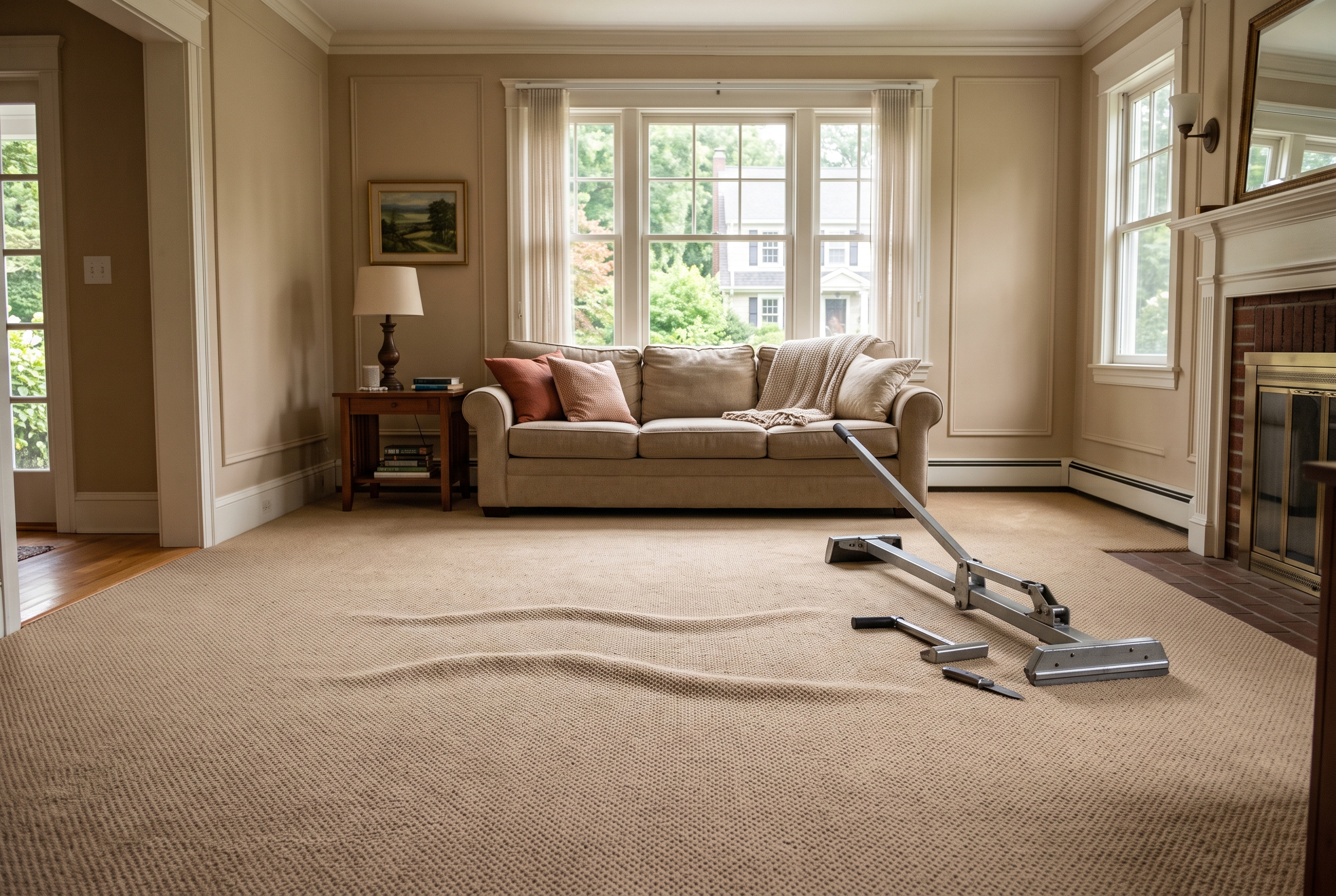
Carpet ripples when it loses tension. Wall-to-wall carpet is held flat by being stretched over tack strips at the edges of the room, and anything that lets it relax leaves slack that rises into ridges. In most rooms a proper re-stretch pulls that slack back out and the carpet lies flat again.
If the ripples showed up in the first year, the carpet was probably not stretched tightly enough. A re-stretch with a power stretcher fixes it, usually for good.
Ripples that come every summer and ease in winter mean humidity is loosening a stretch that was only just tight enough. A re-stretch and a drier house in August fix them.
If they appeared right after a wet cleaning, wait until the carpet is fully dry. Most of those ripples flatten on their own.
A crunchy backing, a lumpy pad or a ripple that follows a seam means a re-stretch alone will not hold. The backing, pad or seam has to be dealt with first.
This table matches what you see to its usual cause and fix.
| What you see | Likely cause | Fix |
|---|---|---|
| Ridges within a year of installation | Not power-stretched | Re-stretch |
| Ripples every summer | Humidity on a loose stretch | Re-stretch, lower humidity |
| Ripples after a closed-up winter | Room left too cold | Re-stretch, keep it warmer |
| Ripples after cleaning | Wet backing | Let it dry fully first |
| Ripples along a furniture path | Heavy items dragged | Re-stretch |
| Soft, spongy feel with ripples | Pad too thick or soft | New pad, then re-stretch |
| Crunchy, loose backing | Backing separating | Repair or replace |
| Ripple running along a seam | Failed seam | Seam repair, then stretch |
What Makes Carpet Ripple
Carpet ripples for one of a handful of reasons, and most of them trace back to how it was installed or the conditions it lives in. The Carpet and Rug Institute, which writes the industry's installation standard, says wrinkles are rarely a manufacturing defect and that proper installation greatly reduces them. Each cause leaves its own clues.
Not Stretched Tightly Enough
Carpet that was not stretched tightly enough at installation is the first suspect, because properly stretched carpet rarely ripples. The standard calls for a power stretcher, a long pole tool braced against the far wall, to stretch carpet about 1 to 1.5 percent in both directions. A knee kicker, the short tool an installer bumps with a knee, only positions carpet on the tack strip. Carpet that was just kicked into place looks fine on day one and loosens as it is walked on.
A cold carpet has the same problem. A roll carried straight in from a cold truck is stiff, and once it warms up in the room it relaxes, however tight it was stretched. That is why carpet should sit in the room for a day before it goes down.
Humidity and Cold Rooms
Humidity and cold rooms both loosen carpet. On a humid Westchester August day, with the windows open and no air conditioning, a carpet that was stretched just tight enough relaxes and ripples, then lies flat again once the heat comes on. Carpet that was stretched properly rarely does this.
Cold works from the other direction. Carpeted rooms should not be allowed to drop under 50 F, however old the carpet is. A second home with the heat turned right down all winter, or a sunroom shut off from the house, can come through to spring with ripples.
The Wrong Pad or a Worn-Out One
A pad that is too thick or too soft lets the carpet flex with every step, and a flexing carpet works loose. Pad for a home should be no thicker than 7/16 inch. An extra-plush pad feels wonderful for a year and then lets the carpet ripple. An old pad that has crumbled, or one that was never fastened down and has bunched up, causes the same trouble from underneath.
Heavy Furniture Dragged Across It
Heavy furniture dragged across carpet pulls the carpet along with it, off the tack strip in front. A sofa, a loaded dresser or a piano can do it in one move, and rolling chairs and carts do it slowly. Ripples that line up with the path something heavy took point to this cause.
Wet Cleaning and Water
Wet cleaning often makes carpet ripple for a while, because the soaked backing swells, and it usually flattens again as it dries. Carpet that stays wet too long is a different matter. A slow-drying cleaning or a leak can weaken the backing, and a flood usually ruins both carpet and pad.
A Backing That Is Coming Apart
A backing that is coming apart makes carpet ripple in a way no stretching can hold. Most carpet has two backings glued together, the first holding the yarn and the second laminated on for strength. When the two separate, which is called delamination, the carpet loses its stability. Age, water and ripples left for years can all cause it, and the ripple then feels crunchy or loose underfoot.
Will Carpet Ripples Go Away on Their Own?
No, except for ripples from wet cleaning, which usually flatten as the carpet dries. Fans or air conditioning speed that up. If the ripples are still there once the carpet is completely dry, it needs a re-stretch. Summer ripples may ease in winter, but they come back every year, and every other kind of ripple stays and gets worse.
Living with a ripple costs more than fixing it. A ripple is easy to trip on, and the raised ridge wears faster, because every footstep and every pass of the vacuum hits it first. Left long enough, a ripple can start to separate the backing. The sooner a rippled carpet is re-stretched, the better its chance of lying flat for good.
How Carpet Re-Stretching Works
Carpet re-stretching releases the carpet from the tack strips, pulls the slack out with a power stretcher and hooks it back on tight. A proper re-stretch follows these steps:
- All the furniture comes out of the room.
- The carpet is unhooked from the tack strips around the room.
- The tack strip is checked to be sure it is nailed down firmly and its pins are sound.
- The pad is checked for wrinkles, and the carpet's back for separation.
- Seams at the doorways are opened so each room can be stretched on its own.
- The carpet is power-stretched in both directions and hooked back onto the strip.
- The extra carpet along the walls is trimmed and tucked, and doorways and vents are seamed back in.
Two parts of that list surprise people. The hallway or the next room often has to be re-stretched too, because carpet that runs through a doorway pulls on both sides, and stretching one room alone lets the ripple come back. And because stretching moves the carpet, doorways and floor vents usually need a small piece seamed in where the carpet no longer meets.
Carpet re-stretch and furniture removal are both on our list of flooring services, so the room can be cleared and stretched in one visit, whoever installed the carpet.
When Re-Stretching Will Not Fix It
Re-stretching fixes slack and nothing else, so when the ripple comes from something under or inside the carpet, that gets fixed first or the ripple returns. A pad that is too thick, too soft or falling apart is replaced before the carpet is stretched over it again. A backing that has separated cannot hold a stretch, so that section is repaired or the carpet is replaced. Carpet that has been through a flood usually goes, pad and all.
Age alone is not the problem. An older carpet in good shape can be re-stretched more than once. But if the carpet is also matted, worn through in the traffic lanes or badly stained, a re-stretch buys a flat floor that still looks tired, and new carpet becomes the better spend. Our carpet catalog is the place to start, and our guide to carpet installation day explains what happens when it goes in.
Carpet Seam Repairs and Patches
A carpet seam that ripples or splits can usually be repaired without replacing anything. A slight ridge along a seam, called peaking, is normal on a power-stretched carpet and shows more on low, cut-pile and loop styles. A seam whose tape has let go, so the two edges gap or ride up, gets re-seamed with new tape, and the room is then stretched.
A burn, a stain that will not come out or a pet-damaged spot can be cut out and patched with a matching piece, ideally from a leftover of the same carpet. That is the best reason to keep the offcuts from an installation. Flooring repairs like these are part of our services, alongside the re-stretch.
Can You Fix Carpet Ripples Yourself?
Yes, but only a small ripple where the carpet edge has come off the tack strip, in a closet or along a short wall. A knee kicker can reseat that edge. It cannot stretch a room, so a room fixed with one ripples again.
A real re-stretch needs a power stretcher long enough to reach across the room, and the know-how to open and reseam doorways and vents. Done wrong, it can tear the backing or pull a seam apart, and then the repair is bigger than the ripple was.
How to Keep Carpet Flat After a Re-Stretch
A properly re-stretched carpet stays flat as long as whatever loosened it does not happen again. In summer, keep the humidity down with air conditioning or a dehumidifier. Lift heavy furniture rather than sliding it.
When the carpet is cleaned, ask for a method that extracts well, so it dries within the day. In winter, keep closed-up rooms at 50 F or warmer. And when the time comes for new carpet, a firm pad of the right thickness and a power-stretched installation are what keep it flat.
Carpet Rippling FAQ
Is Carpet Rippling Covered by Warranty?
No, not usually under the carpet maker's warranty, because ripples come from installation and conditions rather than manufacturing. Carpet warranties generally cover things like wear and staining. If we installed your carpet, call us and we'll come look. If another company installed it recently, its workmanship guarantee is the first call, and our re-stretch service is there either way.
How Many Times Can Carpet Be Re-Stretched?
It depends on the backing and the edges: a sound carpet can be re-stretched more than once, since each time only trims a little at the walls. Carpet that needs a re-stretch every year or two has something else going on, usually the pad or the humidity.
Do Carpet Ripples Come Back After Re-Stretching?
No, not when the job is done with a power stretcher, the connected rooms are stretched together and the pad is right. Ripples do come back after a knee-kicker touch-up, when only one of two connected rooms is stretched, or when the cause, such as a soft pad, is left in place.
Does Woven or Wool Carpet Ripple Differently?
Yes for woven carpet, which is built and stretched differently from the tufted carpet most homes have, so its maker's stretching instructions apply. Wool carpet responds to humidity much like any other, and the same advice holds.
Getting Your Carpet Flat Again
A rippled carpet can almost always be saved once the cause is found along with the slack. Book a free estimate or stop by our Mount Kisco showroom, and we'll check the ripples, the pad and the backing and tell you whether a re-stretch will do it.

