
Wood-Look Porcelain Tile vs. Real Hardwood
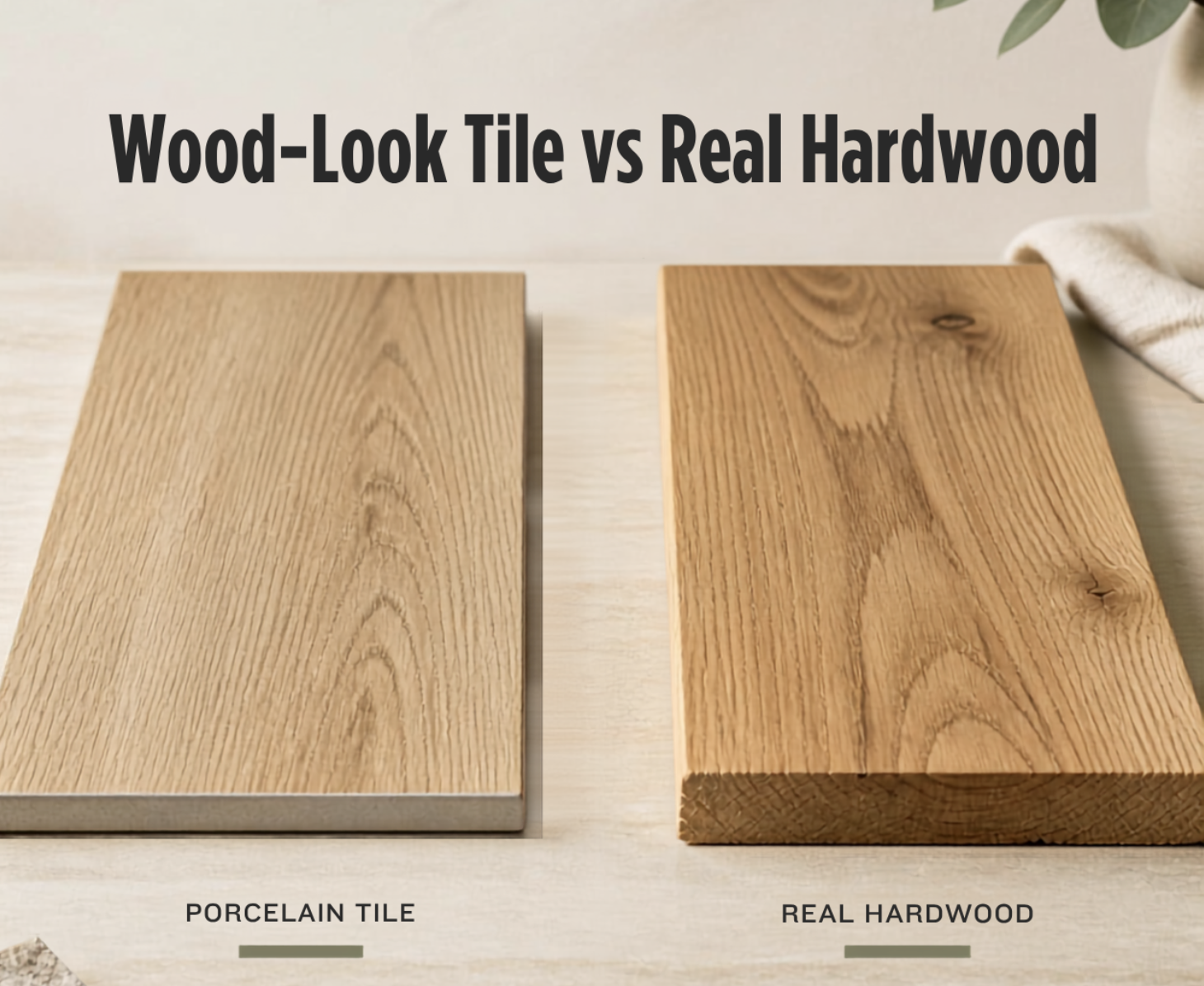
Wood look tile vs hardwood usually comes down to one question: what is the room going to throw at the floor? Wood-look porcelain is a printed porcelain tile that shrugs off water and scratches, so it earns its keep in bathrooms, basements, mudrooms, and homes with big dogs. Real hardwood wins on the things porcelain can't fake — the warmth underfoot, the option to sand it back to new decades from now, and the resale pull a wood floor still carries. We sell and install both. Here's the honest split, measured against the standards that actually define these materials rather than the adjectives on a sample tag.
What Is Wood-Look Porcelain Tile, Exactly?
Wood-look porcelain tile is ordinary porcelain floor tile printed and textured to imitate wood planks. What makes it porcelain rather than plain ceramic is density. Under ANSI A137.1, the ceramic tile specification written by the Tile Council of North America (TCNA), the trade body whose standards most U.S. tile makers build to, a tile earns the name porcelain only when it absorbs 0.5% or less of its weight in water. Plainer ceramic is more porous: vitreous tile runs from 0.5% to 3%, semi-vitreous from 3% to 7%, and non-vitreous above 7%. That near-zero absorption is the whole story. Water barely moves into a porcelain plank, so the tile behaves nothing like the wood it copies. Everything that follows — where it beats hardwood and where it loses — traces back to that one number.
Where Wood-Look Porcelain Beats Real Hardwood
Wood-look porcelain beats hardwood anywhere water, grit, or heavy paws are the daily reality. Because a porcelain plank takes on 0.5% or less of its weight in water, standing spills, wet boots, and shower splashes don't swell it, stain it, or lift its edges the way they do a wood board. In a wet bath or entry, look for a wet dynamic coefficient of friction (DCOF) of at least 0.42, the slip-resistance floor the ANSI A326.3 test sets for floors walked on when wet. Grip and water resistance are built into the tile itself, so they never wear off.
Porcelain also carries a wear rating hardwood has no equivalent for. The PEI scale, from the Porcelain Enamel Institute and measured under ISO 10545-7, grades a glazed surface from Class 1 for walls up to Class 5 for heavy commercial traffic, and a PEI 4 or 5 wood-look tile handles a kitchen or mudroom for decades. Its surface sits high on the Mohs mineral hardness scale of 1 to 10, close to quartz, so a dog's nails or a dragged chair leg do nothing. Dense porcelain is even tested for frost resistance under ASTM C1026, across 100 freeze-thaw cycles, which is why it holds up in an unheated basement and pairs well with radiant heat — tile conducts warmth well. It never needs sanding or refinishing. You'll find plenty of these looks in the tile we stock.
Where Real Hardwood Still Wins
Real hardwood still wins on the things you feel and on the money it returns. A solid 3/4-inch wood floor can be sanded and refinished six to eight times over its service life, per the National Wood Flooring Association (NWFA), the trade group that writes the U.S. standards for wood floors, and each sand-and-finish takes off only 1/32 to 1/16 of an inch. One floor carries a family through scratches, water rings, and three or four color changes. Porcelain offers no version of that. A chipped plank gets replaced.
Hardwood also pays back at resale in a way tile does not. The National Association of Realtors (NAR), in its 2022 Remodeling Impact Report, put the cost recovered on a hardwood refinish at 147% and on new wood flooring at 118%, both with a perfect 10 Joy Score from homeowners who did the work. Wood is warmer underfoot too. Tile conducts heat, so it reads cold on a bare foot, while a wood board holds a room's warmth and gives a little underfoot. If those qualities matter more than waterproofing, start with the hardwood we carry.
Wood-Look Porcelain vs. Hardwood, Side by Side
Side by side, wood-look porcelain and real hardwood split cleanly along water, wear, and warmth. The table below pulls the comparison down to the numbers that decide it.
What you are comparing | Wood-look porcelain | Real hardwood |
|---|---|---|
Water absorption | 0.5% or less (ANSI A137.1) | Swells and stains; wants 30-50% indoor humidity |
Wear resistance | PEI 1-5; choose PEI 4-5 for floors | No abrasion class; the finish wears |
Refinishing | None; damaged planks get replaced | Sanded 6-8 times over its life |
Scratch resistance | High on the Mohs 1-10 scale | Softer; shows dents and claw marks |
Underfoot | Cold, hard; conducts heat for radiant | Warmer; holds room heat, gives slightly |
Resale (NAR 2022) | Valued as tile | 147% refinish, 118% new wood flooring |
Best rooms | Baths, basements, mudrooms, kitchens | Living, dining, bedrooms |
Wood Look Tile vs Hardwood in a Westchester Home
Wood look tile vs hardwood usually sorts itself out room by room in a Westchester home. Around Mount Kisco, an entry and mudroom take road salt, slush, and grit from December through March, and that punishment is exactly where a PEI 4 or 5 wood-look porcelain outlasts any wood board. A below-grade room adds its own case: damp air and freeze-thaw swings suit a tile that absorbs 0.5% or less of its weight in water, while a wood floor there needs the indoor air held at 30-50% humidity all year to stay flat. Bedrooms, the living room, and a formal dining room are the opposite call. Those rooms stay dry, they're where feet land first thing in the morning, and they're where the warmth and resale value of real wood pay off. Our crews install both, and older homes here often need the subfloor flattened first either way.
Questions We Get About Wood-Look Tile vs Hardwood
Does wood-look porcelain add resale value like hardwood?
Wood-look porcelain adds value as a durable, waterproof tile floor, but it doesn't carry the specific resale pull of real wood. The NAR 2022 Remodeling Impact Report scored new wood flooring at 118% cost recovery and a hardwood refinish at 147%, figures that belong to wood. Porcelain's payback shows up instead as a floor that looks the same in fifteen years with almost no upkeep.
Can you refinish wood-look porcelain tile?
You can't refinish wood-look porcelain tile. The color and grain are fired into the surface, so a scratched or chipped plank is chiseled out and swapped for a spare rather than sanded. That's the trade for a floor that shrugs off water. Buy a few extra tiles from the same run at install so a future repair matches.
Is wood-look porcelain cold and hard underfoot?
Wood-look porcelain is colder and harder underfoot than wood, because tile conducts heat and doesn't give. That same conductivity is why the tile industry points to porcelain and ceramic as the best surfaces over radiant floor heating, so warming cables under the tile fix the cold in a bathroom. An area rug handles the hardness in a spot where you stand a lot.
Which floor is better for a house with dogs?
For a house with dogs, wood-look porcelain is the easier floor to live with. Nails that scratch a wood finish do nothing to a tile surface sitting near quartz on the Mohs 1-10 scale, and accidents wipe up off a plank that absorbs 0.5% or less of its weight in water. Hardwood can absolutely live with dogs, but it'll show the wear and want a refinish sooner.
Choosing Between Wood-Look Tile and Hardwood in Your Home
Choosing between wood-look tile and hardwood comes down to matching each floor to the room and the life around it. Put wood-look porcelain where water, salt, and paws win the day, and put real hardwood where warmth, feel, and resale matter more than waterproofing. Plenty of Westchester homes end up with both, and a shared plank width and tone keep them reading as one house. When you're ready to see samples side by side and price it out, request a free in-home estimate and our crews will measure the rooms, check the subfloor, and help you put each material where it earns its place.

