

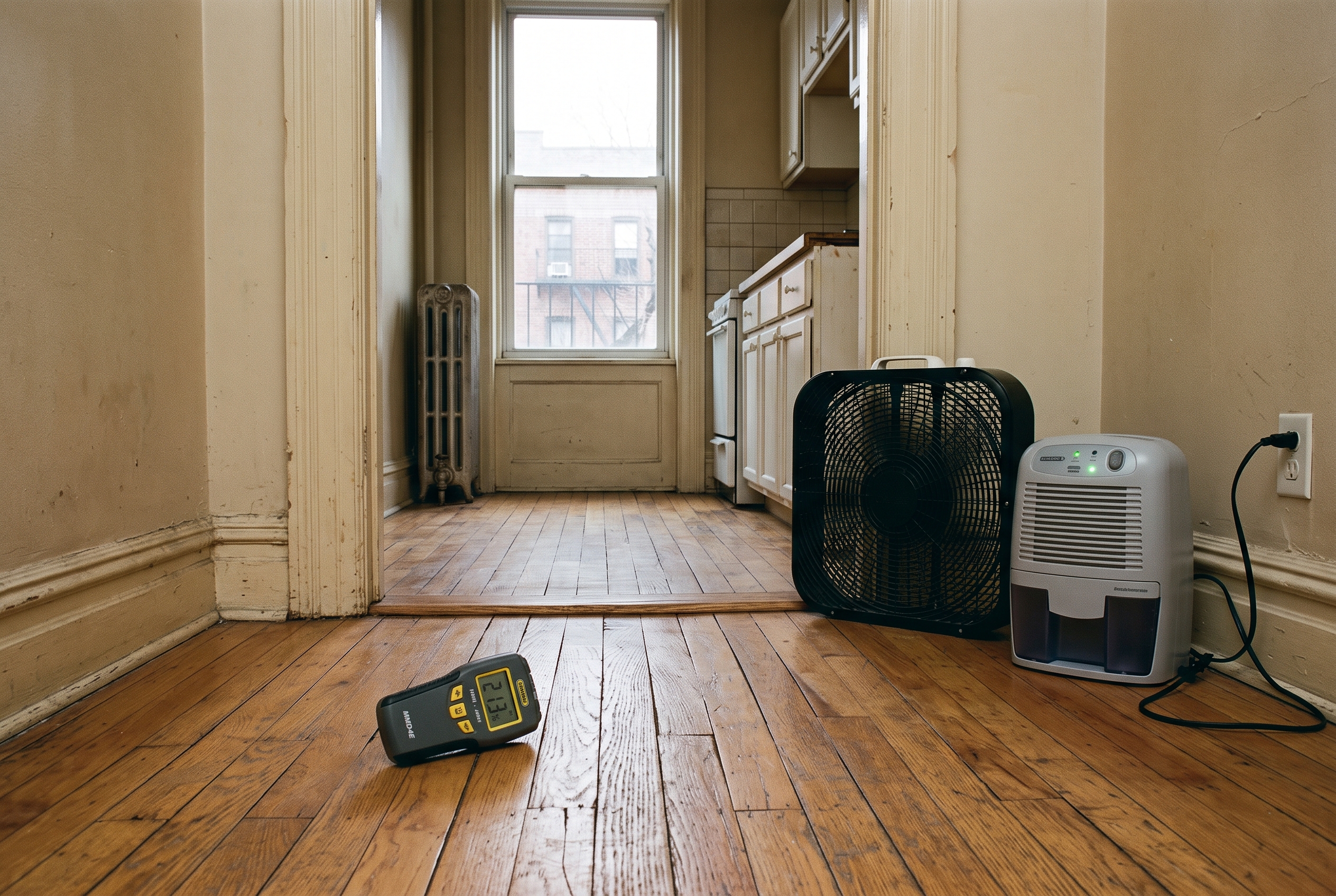
Water-damaged hardwood can usually be saved if the water was clean and drying starts within a day or two. Laminate is less forgiving: planks that have swollen at the seams have to be replaced. What decides it is the kind of floor, the kind of water and how long it sat. Flood service for water-damaged rooms is one of our services, and this is how we judge what stays and what comes up.
Solid hardwood usually survives a clean-water leak. Boards that cup as they take on water tend to flatten again as they dry. Boards that buckle up off the subfloor, or that sat in dirty water, usually come out.
Engineered hardwood can be saved as long as its top layer stays bonded. It dries much like solid wood, but a top layer that has lifted away from its core won't reattach.
Laminate can be saved only where the water stayed on the surface. Planks with puffed-up edges stay swollen after they dry, so they get replaced, and the dry planks around them can stay.
Any floor soaked by sewage or rising floodwater comes up. Once the water is contaminated, the material no longer matters.
This table sorts the usual outcome for each floor.
| Floor | Usually saved when | Usually replaced when |
|---|---|---|
| Solid hardwood | Clean water, boards only cupped | Boards buckled off the subfloor |
| Engineered hardwood | Clean water, top layer still bonded | Top layer bubbling or peeling |
| Laminate | Water wiped up before reaching seams | Edges swollen or peaked |
| Any floor | Clean water, drying started fast | Sewage or rising floodwater |
What to Do in the First 48 Hours After a Leak
The first two days after a leak decide most of what can be saved, because water keeps soaking into wood and spreading under planks for as long as it sits. The EPA says damp materials dried within 24 to 48 hours usually don't grow mold. These steps are for water that pooled, ran under the baseboards or leaked for an unknown time. A spill you wiped up in minutes needs nothing more than a dry towel.
- Stop the water at the fixture valve or the main, and turn off power to any wet outlets or appliances.
- Take photos of the source and the wet floor before you start cleaning.
- Get the standing water up with towels, a mop or a wet-dry vacuum, including along the walls and under the cabinet toe kicks.
- Lift area rugs and move furniture off the wet floor, because a rug holds water against the boards.
- Run fans across the floor and a dehumidifier in the room with the doors and windows closed.
- Keep the heat or air conditioning at its normal setting, unless the water reached the ducts or the unit.
- Hold off on sanding, staining, nailing or weighing down anything.
If you live in an apartment or co-op and the water came from upstairs, tell the super or managing agent the same day. They need to stop it at the source, and the building's insurance and yours may both be involved. Photograph your ceiling and walls as well as the floor. In older Yonkers buildings, a steam radiator valve or a riser can leak slowly before anyone notices, so check under the radiator if the floor near one looks dark.
Clean Water, Dirty Water and Floodwater
Clean water gives a floor its best chance, and grossly contaminated water means the floor comes out. Restoration crews follow the IICRC's water-damage standard, which calls that worst group Category 3 water and includes sewage, drain backups and water that rose from a river or stream. If a restorer uses that term about your basement, the flooring it touched is coming up.
This table shows how the source of the water changes the outlook for the floor.
| Water | Typical sources | What it means for the floor |
|---|---|---|
| Clean | Supply line, burst pipe, water heater, radiator valve | Best odds; dry it and judge it |
| Dirty | Dishwasher or washer drain water, toilet overflow without waste | Clean and dry fast; shorter window |
| Contaminated | Sewage, drain backup, rising river or stream water | Floor and underlayment removed |
Clean water doesn't stay clean for long. Water that sits for a couple of days picks up whatever it soaks through, so a slow leak found late is handled as dirtier than the same leak found that morning.
Weather alone doesn't decide it either. Rain blown in through a window isn't automatically treated as contaminated, but water that backed up through a basement floor drain is. Water that seeped through a foundation wall is classified by the restorer after an inspection.
When Solid Hardwood Cups, Crowns or Buckles
Solid hardwood cups after a leak because the underside of each board soaks up more water than the finished top, so the bottom swells and the edges rise higher than the center. As the boards give that water back to dry air, they slowly settle. It takes steady temperature, steady humidity and time, and very badly cupped boards may not come all the way back.
If your boards cup every summer and flatten every winter without any leak, that is seasonal movement rather than water damage. Our post on hardwood floor gaps and cupping covers that pattern.
When a Cupped Floor Can Be Sanded
A cupped floor can be sanded only after it has finished drying, or the damage becomes permanent. Sand it early and the machine cuts the raised edges flat. Then the boards finish drying, the edges shrink back, and the centers end up higher than the edges. That is crowning, and fixing it means sanding again and losing more wood.
Go by the meter, not the calendar. A moisture meter from a hardware store will do.
Take readings in the wet area and in a dry room of the same house, and the floor is ready when the two match and stay matched for several days. Federal flood-cleanup guidance puts 15 percent as the upper limit for refinishing, and a healthy floor in a heated home reads well under it. Depending on how much water got in, the wait runs from days to weeks.
Once the floor has settled, a sand and refinish takes out the leftover unevenness and light gray marks. A 3/4-inch solid floor can be sanded four to six times in its life, so one sanding after a leak costs it little. Our hardwood floor refinishing crews do that part.
Buckled Boards and Black Stains
Buckled boards have swollen so hard against each other that they lifted clear off the subfloor and pulled their nails. A few can be pressed back down after drying, but most are cut out and replaced, and the subfloor gets checked while they're up.
Dark gray or black marks that show up after a leak come from a reaction between the water, the natural tannins in oak and the iron in the nails. Light gray shadows usually sand out. Deep black marks usually mean a new board, and it is better to know that before the floor is refinished than after.
Is Engineered Hardwood Easier to Save?
Yes, a little. Engineered hardwood's layered core moves less than solid wood when it gets wet, and it dries the same way, with air, dehumidifiers and a meter. Whether it can be saved comes down to one check: is the real-wood top layer still bonded to the core?
Look for bubbles in the surface, edges that peel or curl, or a hollow sound when you tap a board. Drying won't glue that layer back down, so boards that have separated get replaced.
The top layer's thickness decides how much sanding the floor can spare. A standard engineered top layer is about 1/16 inch thick and can be refinished only once or twice. If a leak leaves the boards slightly uneven after drying, sanding that out could use up the floor's last refinish, and replacing a few boards is sometimes the smarter trade.
How the floor was installed matters as well. An engineered floor clicked together over underlayment can hold water underneath the whole floor, so it usually has to be lifted for the subfloor to dry. One glued to a concrete basement slab is only as good as the slab: if the slab stays wet, the floor comes up.
To check a concrete slab, tape a square of clear plastic to it and leave it about 16 hours. Moisture on the underside of the plastic means the slab is still too wet for any new floor.
Laminate After a Leak or Spill
Laminate is saved or lost at its core. The surface is a tough printed layer, but the core underneath is wood fiber pressed with resin, and when water reaches it through a seam or a cut edge, the fibers swell. That swelling doesn't go back down when the plank dries. It is such a known weakness that the laminate industry's own standards include a test that soaks a plank for a day to measure it.
Run your hand along the seams in the wet area. Raised, puffy or soft edges mean water got into the core, and those planks are replaced. Planks with flat, crisp edges can stay.
Water-resistant and waterproof laminates are made to protect the floor from spills and splashes on its surface. A slow leak from a dishwasher or refrigerator line is a different problem, because the water runs underneath the floor and sits there. Our post on what water-resistant laminate really means covers that difference when you are choosing a floor.
Can Water Under Laminate Dry Without Lifting the Floor?
No, not reliably. Laminate floats over a foam underlayment and often a plastic moisture barrier, and those hold water against the subfloor where fans on the surface can't reach it.
The planks near the leak come up, starting from the nearest wall. The wet underlayment is replaced, and the subfloor dries until a meter says it is ready. Mohawk, whose laminate we carry, wants a wood subfloor at 12 percent moisture or less before its planks go down. Planks that stayed flat can usually click back in, and swollen ones are replaced.
Check the Subfloor and Watch for Mold
A floor can look dry while the subfloor underneath is still wet, so the subfloor is always part of the check. Soft or spongy spots, a musty smell that lingers, dark staining on the underside of lifted boards and panels swollen at their edges all point to water that is still there. A panel that dries flat and firm can stay. One that swelled or went soft is replaced, and subfloor repair is one of our services, so that happens in the same project.
A musty smell that hangs on after the floor looks dry, or fuzzy growth on the underside of boards, means the area has to be opened up and dried properly. The EPA treats a moldy patch smaller than about 3 feet by 3 feet as a job you can usually clean up yourself. Anything larger, or mold after a lot of water damage, is a bigger cleanup that follows professional remediation guidance.
What to Photograph and Keep for Insurance
A standard homeowners policy usually covers water that escapes suddenly from plumbing, heating or an appliance, such as a burst pipe or a failed washing machine hose. It usually doesn't cover flooding from outside, which needs a separate flood policy, or damage from a slow leak that was left to go on. Sewer backup is usually excluded unless the policy has an endorsement for it. Your own policy is what counts, so read it or call your agent before the floor comes out.
FEMA's advice is to photograph the damage before cleanup starts and to keep samples of damaged flooring. For a wood or laminate floor, keep these, which also help us match the floor later:
- Wide photos of each room, and close-ups of cupped boards, swollen seams and stains.
- A photo of the source: the pipe, the hose, the appliance or the ceiling.
- One damaged board or plank, kept in a bag.
- The label from any spare carton, with the brand, color name and lot number.
Putting the Floor Back Together
Drying out is the restoration half of a water-damaged floor, and making it look like one floor again is ours. Replacement hardwood boards are woven in among the old ones, then the room is sanded and finished together so the repair disappears.
Laminate is matched plank for plank, which is why spare cartons matter. Mohawk recommends buying extra cartons for future repairs, and a leak is when you'll be glad you did.
No spare cartons? Bring a plank or a photo of the old carton label to one of our showrooms, and we'll check whether the floor is still made. If it isn't, a closet or the space under a built-in can often donate matching planks to the repair.
If the room is likely to see water again, choose the next floor with that in mind. Basements, laundry rooms and kitchens with a history of leaks are the usual candidates. Our guide to moisture-smart basement flooring in Yonkers walks through the options, and some of the laminate in our catalog is rated waterproof.
Flood service, subfloor repair, flooring repairs and hardwood refinishing are all on our list of services, and our installation and repair team handles the full scope as one project. When lifting the floor turns up a soft subfloor, the fix happens in the same job instead of stalling it.
Water-Damaged Floor FAQ
How Long Can Water Sit on Hardwood Before It Causes Damage?
Minutes are fine and hours are not. The finish on hardwood slows water down, but the seams between boards don't, and water that sits for hours starts to raise the grain and cup the boards around it.
Will a Fan and a Dehumidifier Dry a Floor on Their Own?
Yes for a spill on the surface, no for water that got under the floor. Air moving across the top can't reach a wet subfloor or wet underlayment, which is why floating floors get lifted and deeply soaked wood floors are dried with specialized equipment.
Can I Put a Rug Over Cupped Boards While They Dry?
No. A rug over cupped boards traps moisture against the floor and slows the drying, and a rubber-backed rug is worse. Leave the area bare until the meter readings settle.
Should I Call a Restoration Company or a Flooring Store?
It depends on what is on the floor right now: standing water in several rooms has to come out the same day, whoever gets there first, because the floor's chances drop by the hour. Deciding which boards stay, when to sand, what to replace and how to match the rest is flooring work, and that is what our flood service and repair team are for.
How Much Does It Cost to Repair a Water-Damaged Floor?
It depends on how many boards or planks come out. We price the repair at a free in-home estimate, where we also check whether the subfloor needs work and whether the room has to be refinished to blend.
Get a Wet Floor Looked At
If you've had a leak, get the water up and the air moving, then request a free in-home estimate. We'll tell you what can be dried and kept, what should come up, and what it will take to make the floor look like one floor again.

