

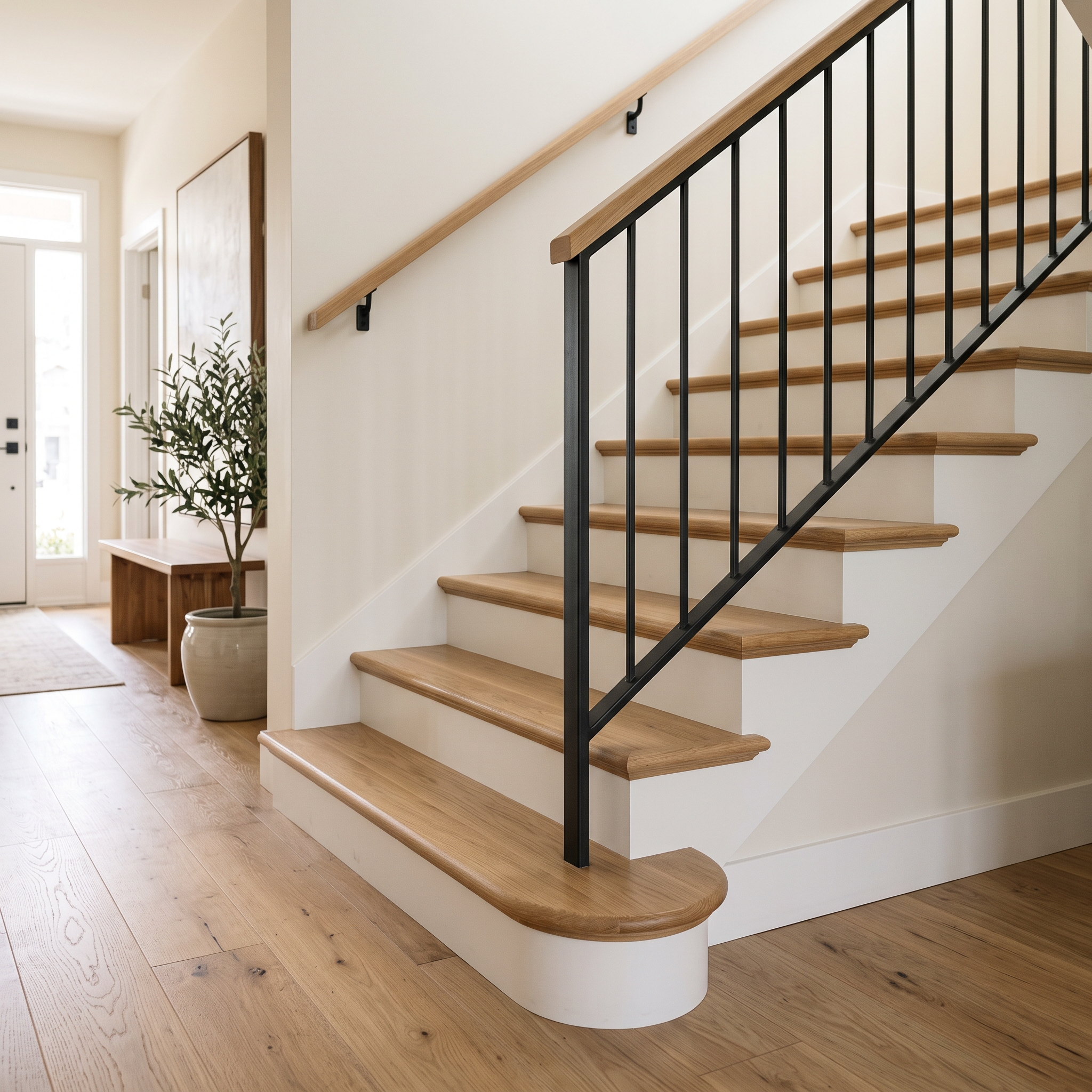
Yes, laminate flooring can go on stairs, as long as every tread is glued down instead of floated and every front edge gets a matching stair nose. It carries a laminate floor up the staircase in the same look and stands up well to wear. Whether it works on your stairs depends on how sound they are, how the new thickness changes the step heights, and how you plan for grip.
Laminate on stairs is glued, never floated. The foam pad attached to many planks comes off, and each piece is glued to the step.
Every step needs a stair nose. A matching nose covers the front edge, which takes more wear than any other part of a staircase.
Carpeted stairs need prep before laminate. Tack strips, staples and old pad come out, and loose treads get fixed first.
Plan for grip from the start. A textured laminate helps, and a runner down the middle adds the most traction.
This table shows the parts of a laminate staircase and what each one does.
| Part | What it does | Options |
|---|---|---|
| Tread | The surface you step on | Two cut planks, or a one-piece tread |
| Stair nose | Finishes and protects the front edge | Flush-mount or overlap |
| Riser | The vertical face of each step | Laminate, paint or wood |
| Top step | Where stairs meet the floor above | Overlap nose |
| Open side | The exposed end of each step | Mitered return piece |
Why Stairs Change the Rules for Laminate
Laminate floats on a floor, and on stairs it can't. On a floor, the planks click together into one sheet that rests on its underlayment and moves slightly with the seasons. A plank floating on a stair tread would shift under every step and work loose, so on stairs each piece is glued down.
Mohawk, whose laminate we carry, calls for the attached pad to come off the planks and for planks and noses to be glued with a stair-tread adhesive or a polyurethane construction adhesive. Each piece still gets a hairline gap at the sides and back, about 1/16 to 1/8 inch, so the core has room to move.
Each step is measured and cut on its own, because the steps in an older staircase are rarely identical. A typical tread is deeper than one plank is wide, so each tread takes two pieces joined together, or a one-piece laminate stair tread where the maker offers one. The adhesive then has to cure before the stairs take full traffic, usually a day or two.
Flush or Overlap Stair Nose?
Flush on most steps, overlap at the top. A flush-mount stair nose sits level with the laminate on the tread and locks into the plank behind it, so each step reads as one solid tread. An overlap nose has a lip that rests on top of the flooring.
The overlap nose belongs at the top step, where the staircase meets a floating laminate floor. That floor has to stay free to move, and the lip covers the joint without pinning it down.
Laminate makers sell noses to match their floors, so when you buy laminate from us, ask for the matching stair nose with the planks. The best-matching planks are saved for the most visible steps.
On a staircase with an open side, a mitered return piece wraps the nose around the exposed end of each step. Any balusters that come out for the work go back in firmly secured before the stairs are used.
Putting Laminate on Carpeted Stairs
Most laminate staircases start as carpeted ones, and the carpet usually hides work that has to happen first. Under stair carpet there are tack strips, dozens of staples, old pad and sometimes rough treads that were never meant to be seen. All of it comes out, and the steps are cleaned of old paint, wax or adhesive so the new glue can bond.
Loose or damaged treads and risers are repaired or replaced before any laminate goes on. A squeak you ignored under carpet becomes a squeak you hear under a glued floor.
If the treads have a rounded bullnose edge that sticks out past the riser, the installer decides at the stairs whether the new nose fits over it or the overhang is trimmed back. If your stairs are finished hardwood in sound condition, laminate can go right over them once the surface is lightly sanded so the adhesive grips.
Keeping the Step Heights Even
Adding laminate to stairs raises every tread by the thickness of the new floor, and that matters most at the top and bottom steps. The residential building code New York uses limits how much step heights in one flight can vary: no more than 3/8 inch between the tallest and shortest riser. Your feet expect every step to match the last, so an odd step is a trip hazard.
In the middle of the staircase, every tread rises by the same amount, so those steps stay even. At the bottom, the first step gets taller unless the floor at the foot of the stairs is raised by a new floor too. At the top, the last step gets shorter unless the floor upstairs gets the same new laminate.
When the floors at both ends change along with the stairs, the heights usually work out. If the hall upstairs stays carpeted, the top step's height and edge are worked out when the stairs are measured.
Older Yonkers houses, two-family homes especially, often have steep, narrow stairs with little room for error. Measuring every riser before anything is ordered tells you whether the plan works.
Is Laminate Slippery on Stairs?
Yes, smooth laminate can be slippery on stairs in socks or wet shoes, and a textured surface or a runner fixes most of it. Laminate with a textured, embossed surface gives feet more to grip than a smooth, glossy one.
A stair runner adds the most traction, and it quiets the steps too. Glued laminate has no pad under it, so bare laminate stairs are louder underfoot than carpet. A runner goes over laminate stairs the same way it goes over hardwood. Our stair runners page shows the styles, and our post on stair runner safety and style covers choosing one.
With young kids, a dog, or anyone who is unsteady on stairs, plan the runner and the laminate together rather than adding one later.
Laminate, Hardwood Treads, Carpet or a Runner?
Choose laminate for stairs when it matches the laminate floor it leads from. This table shows where each option fits.
| Stair option | Best when | Trade-off |
|---|---|---|
| Laminate | It matches a laminate floor | Can't be refinished; plan for grip |
| Hardwood treads | They match a hardwood floor | Usually costs more; can be refinished |
| Carpet | You want soft, quiet stairs | Front edges show wear first |
| Laminate or wood plus a runner | You want the look plus grip | Runner needs regular cleaning |
Laminate's clear wear layer resists scratches from shoes and paws. The Mohawk laminate we carry is rated AC4, a wear class rated for light commercial traffic, and stairs are where that rating earns its keep, because every step lands on the nose.
How Long It Takes and What It Costs
The time and cost of laminate stairs run higher per square foot than the same area of floor, because each step is measured, cut, glued and finished on its own. Removing carpet, repairing treads, open sides and landings all add to both, and the adhesive needs its cure time before heavy use.
Stairs are priced by the staircase, and the number of steps, open sides, landings, repairs and a runner all change the number. We price it at a free in-home estimate after measuring every riser. Our installers work across every product category we carry, laminate included.
Laminate Stairs FAQ
Do You Need Underlayment Under Laminate on Stairs?
No. Laminate on stairs is glued straight to the tread, and any pad attached to the planks is removed first.
Can You Put Laminate on Stairs Without a Stair Nose?
No. Without a stair nose, the cut edge of the laminate is exposed at the front of every step, where it would chip and wear through quickly.
Does the Laminate on the Stairs Have to Match the Floor?
No, but it usually should. Laminate stairs that match the floor they come from look planned, and makers sell stair noses to match each color.
Can You Put Laminate on Stairs Yourself?
Yes, if you can measure and cut each step precisely and work cleanly with construction adhesive. It is one of the harder laminate jobs, because mistakes show on every step and a loose nose is a safety problem.
Plan Your Staircase With Us
If you are putting laminate downstairs and wondering about the staircase, request a free in-home estimate. We'll measure every step, check the heights at the top and bottom, and show you laminate, noses and runners that work together.

