

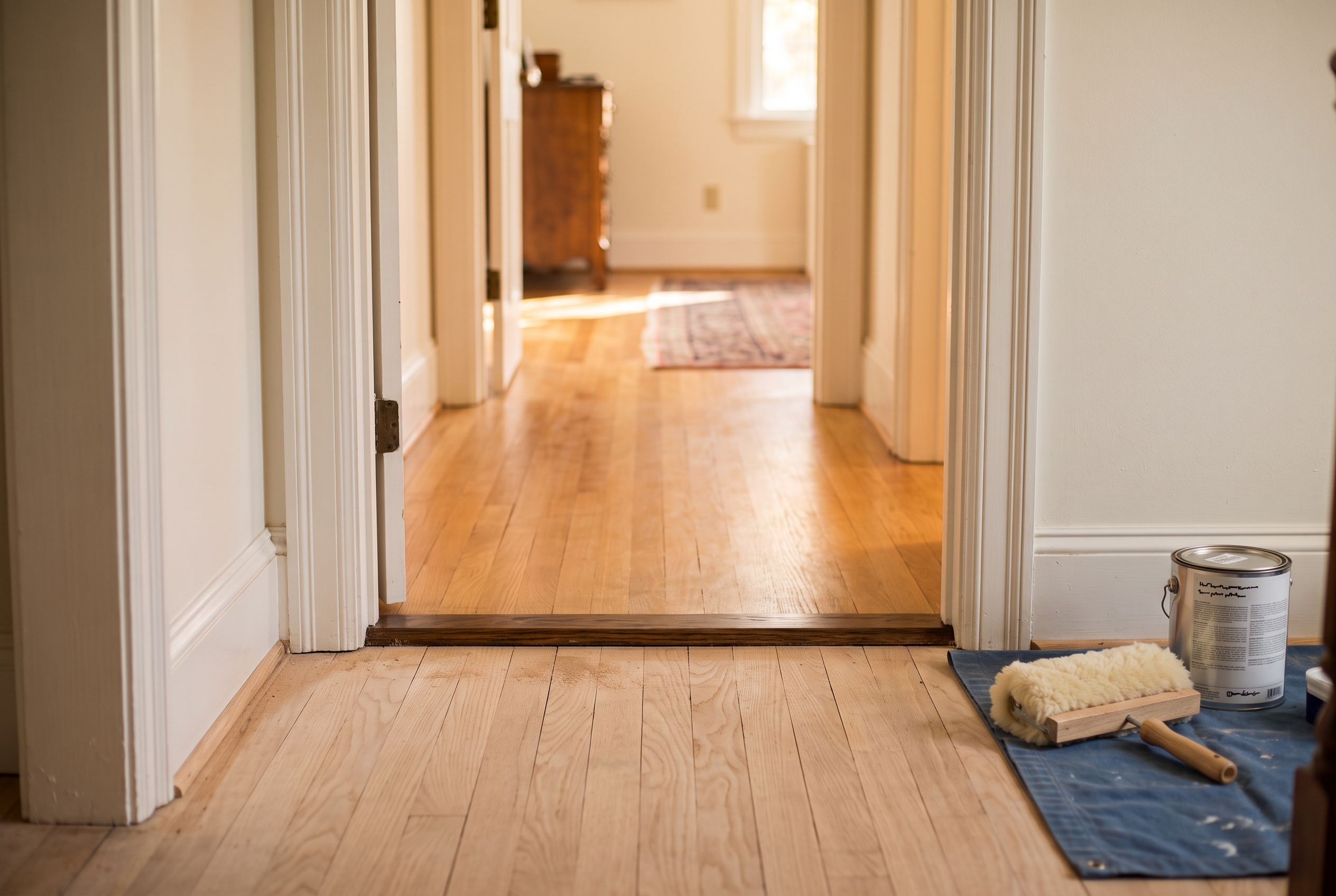
Prefinished hardwood arrives sanded, stained and sealed from the factory, so you can walk on it the day it goes in. Site-finished hardwood, often called unfinished hardwood, is installed raw and then sanded, stained and coated in your house over several days. Most new floors today are prefinished. Site finishing earns its place when you want a custom color or an invisible match to an existing floor.
Choose prefinished when you want the room back fast. There is no sanding dust or finish smell in the house, and the factory finish is harder than any finish applied in a room.
Choose site-finished when color or a match matters most. Raw boards take any stain, and they can be sanded together with an old floor so new and old look like one.
This table sets the two side by side on the points that usually decide it.
| What differs | Prefinished | Site-finished |
|---|---|---|
| Walk on it | The day it is installed | After the last coat dries |
| Time in your house | Installation only | Several extra days |
| Dust and smell at home | None from finishing | Sanding dust, finish odor |
| Finish | Factory-cured, very hard | Two or three coats, easy to renew |
| Edges | Small bevel on many boards | Flat, one continuous surface |
| Color | The maker's range | Any stain, mixed to order |
| Matching an old floor | Close, rarely exact | Sanded and stained as one |
What Prefinished and Site-Finished Hardwood Mean
Prefinished hardwood is finished in a factory before it is boxed. The boards are sanded, stained and given several coats of urethane, cured in seconds under ultraviolet light. It comes in both solid and engineered construction, and every floor in our online hardwood catalog is prefinished.
Site-finished hardwood arrives as bare wood. It is installed first, then sanded flat, stained if you want color, and given two or three coats of finish in the room itself. Our hardwood buying notes call this Finish in Place. Until the 1940s it was the only way a wood floor was done, which is why the old oak floors in so many Mount Kisco houses are site-finished.
Factory finishing had an unlikely start. Hardwood Floors magazine traces it to World War II, when mills building Navy boats from oak plywood cut their scraps into small blocks. They coated the blocks with wax and sold them as flooring, and the first factory-finished wood floors were born.
Which Finish Holds Up Better
A factory finish is the harder of the two. Most prefinished floors carry aluminum oxide particles in a UV-cured urethane, a coating that can only be applied on a factory line. That hardness is why prefinished floors shrug off the grit, chair legs and dog nails that wear a floor down.
A site finish trades some hardness for being easy to renew. Two or three coats of a good urethane wear well in a busy house. When they dull, a light sanding and a fresh coat bring them back.
A factory finish can be recoated too. Because it is so hard, though, the recoat usually starts with a chemical bonding treatment rather than a quick buff and coat, and the floor's bevels make hand work along the edges part of the job.
Sheen matters as much as the finish type. The less shine a floor has, the less you notice small scratches, and most of our hardwood catalog is low gloss for that reason. Our post on hardwood finishes that hide wear goes further into sheen, color and texture.
Bevels, Seams and Winter Gaps
Many prefinished boards have a small bevel along their edges, a slight V where two boards meet. The bevel lets boards line up cleanly even when they differ by a hair in thickness, and it hides the thin gaps that open between boards in winter. Some prefinished floors have only a fine micro-bevel, so the look ranges from crisp lines to nearly flat.
A site-finished floor is sanded flat after it is installed, so it has no bevels at all. The finish runs across the seams and leaves one smooth, continuous surface, the traditional look of an old oak floor.
That continuous finish has a side effect worth knowing in a Westchester winter. Finish that runs into the seams can glue a few boards together. When the heat dries the house out, the floor then opens a wider gap every few boards, instead of a hairline gap at each one.
The fix is the same for both floors. The NWFA recommends keeping a house with wood floors between 30 and 50 percent humidity all year, and a humidifier on the furnace does most of that work in January.
How Long Each Takes, and Living at Home During the Work
A prefinished floor takes no extra days: it is ready when the last board is in. You can walk on it right away and move the furniture back the same day, with no sanding in the house and no finish smell.
A site-finished floor adds several days after installation. Sanding comes first, then the stain if you chose one, then the coats of finish with drying time between each. Your quote should list those days.
After the last coat you wait a day or so before walking on it in socks, and a few more days before the furniture goes back. Rugs wait until the finish has fully cured.
Sanding is dusty however carefully it is done. Our buying notes are candid that a floor finished in place is never entirely dust-free, because a speck or two settles in the wet finish.
If you are staying in the house with small children, pets or anyone sensitive to odors, prefinished is usually the easier path. If you can be away for the finishing days, site finishing is much simpler to live with.
Custom Colors and Matching an Existing Floor
Site finishing gives you any color you can imagine. Raw oak takes any stain, blended to order and tested on boards in your own light before the whole floor is done. Prefinished colors are the maker's range. Our catalog alone runs to about 1,600 hardwood colors, but it is still a set menu.
Matching an existing floor is where site finishing is hardest to beat. Unfinished boards can be woven into the old floor and the whole connected area sanded and finished together, so the join disappears. The connected area means every room that runs into the new one without a threshold, because those floors have to finish the same color. Our post on matching new hardwood to an existing floor covers that project, and we plan it with you at the free measure.
A prefinished floor in the same species and a close color is the other route. It usually meets the old floor at a threshold, or changes direction at the doorway, so a slight difference reads as intentional.
Herringbone, borders, inlays and medallions are traditionally site-finished too, because the pieces are sanded flat together after they are laid.
Refinishing Prefinished and Site-Finished Floors Later
Both kinds of floor can be sanded and refinished when there is enough wood. Solid hardwood, prefinished or not, is usually 3/4 inch thick and can be sanded several times over its life. The factory finish takes more work to sand through the first time, because it is so hard.
Engineered hardwood can be refinished when its real-wood top layer is thick enough, around 2.5 millimeters or more on a smooth prefinished board. Three of the makers we carry, Lauzon, Mirage and Somerset, are on the NWFA's list of Certified Refinishable manufacturers, which covers engineered floors made thick enough to sand again.
When one board is damaged on a prefinished floor, the usual fix is replacing that board, which is why we suggest keeping a spare carton. When a solid floor of either kind is worn through, our hardwood refinishing crews sand it back to bare wood and finish it again.
Which Costs More
The two usually land closer than people expect. Unfinished boards cost less per square foot than prefinished boards of the same species, but site finishing adds days of sanding, staining and coating labor. Prefinished costs more in the box and less on the job. Which comes out ahead depends on the room, the species and how much sanding the floor needs, so we price your floor both ways at the free measure when both make sense.
If you are comparing two quotes, one of each, check that they cover the same things:
- How many coats of finish, and which kind, for the site-finished floor.
- Whether stain is included, and whether you see a sample on your own boards first.
- Which rooms get sanded, including any old floor that joins the new one.
- How many days each job takes, and who moves the furniture.
- For an engineered floor, how thick the real-wood top layer is.
Which One Is Right for Your Home
The right choice for your home usually follows from two things: whether you will live there during the work, and whether the new floor has to meet an old one. This table covers the situations we see most.
| Your situation | Usually the better fit |
|---|---|
| New floor, staying home during the work | Prefinished |
| Adding a room onto an existing oak floor | Site-finished |
| Dogs, kids and heavy daily traffic | Prefinished, low sheen |
| A custom stain color | Site-finished |
| Herringbone, borders or inlays | Site-finished |
| Engineered wood over concrete or radiant heat | Prefinished engineered |
| Old subfloor with small dips and humps | Site-finished, sanded flat |
A prefinished floor wants a flat subfloor, because it cannot be sanded level after it goes down, while a site-finished floor is sanded flat as part of the job. That is why the old-subfloor row favors a site finish. Engineered floors made for a slab or radiant heat are almost always sold prefinished, so that row is simply what is made.
Our hardwood catalog carries prefinished solid and engineered floors from Bruce, Somerset, Lauzon, Mirage, DuChateau, Bella Cera, Chesapeake, Indusparquet, Maine Traditions and Mohawk. You can sort it by species, width, construction and sheen before you visit, and our installers put down every floor in it.
Prefinished and Site-Finished Hardwood FAQ
Can You Stain Prefinished Hardwood a Different Color?
No, not without sanding the factory finish off first. Stain has to soak into bare wood, and a factory finish seals it. A solid prefinished floor, or an engineered one with a thick enough top layer, can be sanded to bare wood and then stained any color.
Is Prefinished Hardwood Real Wood?
Yes. Prefinished solid hardwood is one piece of real wood, and prefinished engineered hardwood has a real-wood top layer over a stable core. Only the finish is applied in the factory rather than in your house.
Do the Grooves in Prefinished Floors Collect Dirt?
Yes, a little, and a dry dust mop or a vacuum with a hard-floor head clears them. Wide boards and fine micro-bevels show less of it than narrow boards with deeper bevels. If you want no grooves at all, look at square-edged boards or a site finish.
Which Is Better in a Kitchen?
It depends mostly on the floor next door. Both work in a kitchen when spills are wiped up promptly: a site finish seals across the seams, and a factory finish stands up well to the traffic between sink and stove. When the kitchen opens onto an existing oak floor, the match usually decides it.
Deciding on Your Hardwood
The choice comes down to time, color and what your new floor has to meet. Bring a photo of any floor you need to match to our Mount Kisco showroom. Or book a free in-home estimate, and we'll check your rooms, your subfloor and your schedule and price the floor that fits.

