

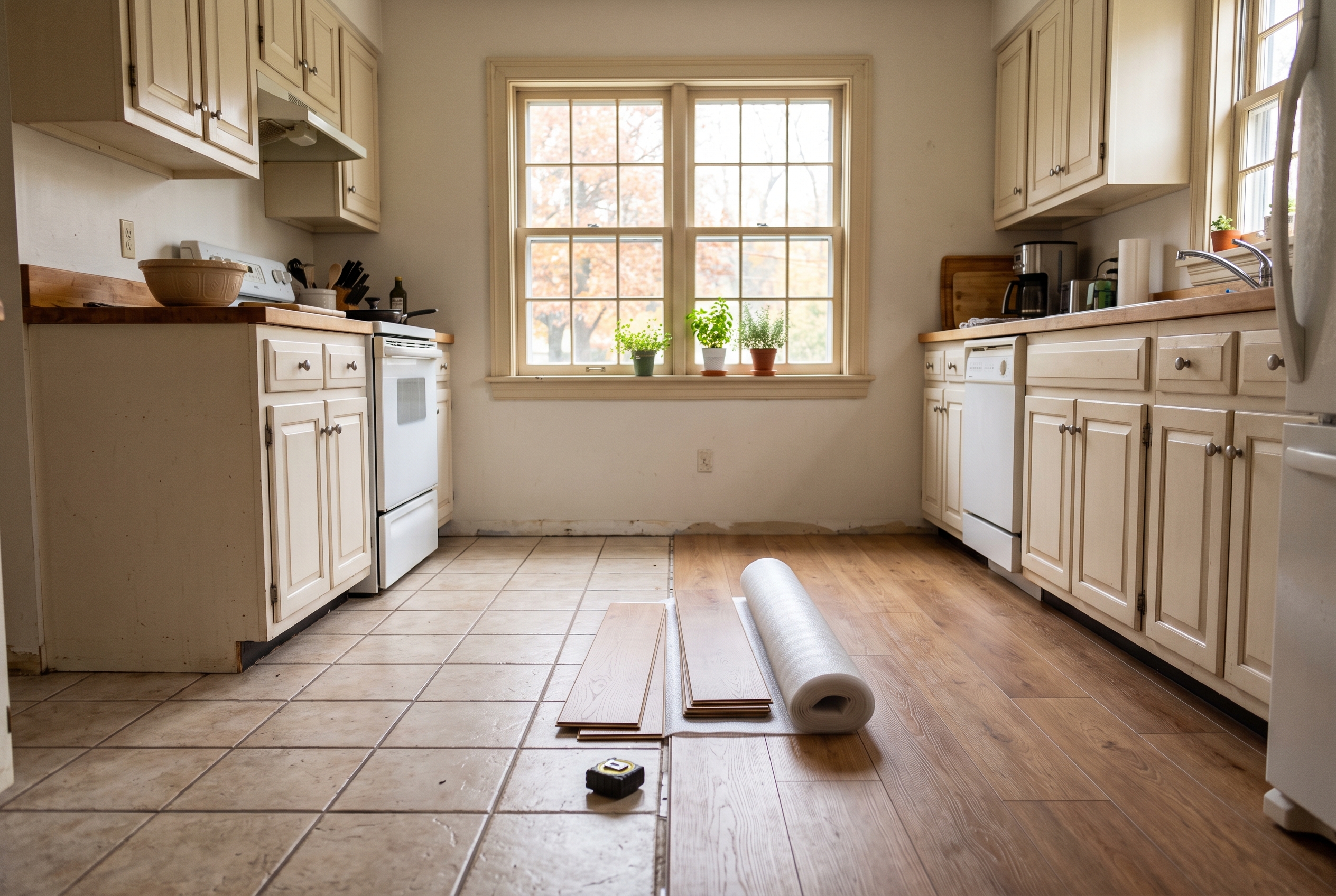
Yes, laminate can go over most ceramic tile, sheet vinyl and hardwood, as long as the old floor is flat, solid and dry. Laminate floats on a thin pad and locks to itself, so it is never glued or nailed to what is underneath. The catch is height: the new floor sits almost half an inch higher, which matters at doors, thresholds and the dishwasher.
Over ceramic or porcelain tile, usually yes. Tile that is firmly stuck down makes a good base once loose or cracked tiles are fixed and deep grout lines are filled.
Over sheet vinyl, linoleum or glued vinyl tile, usually yes. The old vinyl should be one layer, glued down everywhere and not cushioned. If it is old enough to contain asbestos, leaving it in place and covering it is the safer plan.
Over hardwood, yes when it is nailed down and flat. The new planks run across the old boards. Wood glued straight to concrete, like parquet on a slab, comes up first.
Carpet, old laminate and click vinyl plank have to come up. A soft or floating layer underneath lets the new joints flex until they open.
This table sorts the floors we find in Westchester houses by whether laminate can go straight over them.
| Existing floor | Laminate over it? | What has to be true first |
|---|---|---|
| Ceramic or porcelain tile | Yes | Flat, no loose or cracked tiles |
| Natural stone | Sometimes | Only if smooth and level |
| Sheet vinyl or linoleum | Yes | One layer, fully glued, not cushioned |
| Glued vinyl tile or plank | Yes | Flat and firmly stuck down |
| Click vinyl plank | No | Take it up first |
| Hardwood nailed to a wood subfloor | Yes | Flat, no loose boards or cupping |
| Wood glued to concrete | No | Take it up first |
| Old laminate or bamboo | No | Take it up first |
| Carpet | No | Carpet, pad and staples come out |
Putting Laminate Over Ceramic or Porcelain Tile
Ceramic and porcelain tile make one of the best bases for laminate, because a well-set tile floor is hard and stable. The North American Laminate Flooring Association lists both as suitable, as long as the tile is flat and no tiles are cracked or loose. Those two conditions are where the preparation goes.
A cracked tile, or one that sounds hollow when you tap it, has let go of its bed. Under a floating floor it can rock and click with every step. We take loose tiles out and fill the gap with floor patch, level with the tiles around it.
Grout Lines and Uneven Tiles
Grout lines and uneven tiles matter only when they make the floor uneven, because laminate needs a flat base more than a smooth one. The laminate we carry asks for no more than 1/8 inch of dip across 3 feet, or 3/16 inch across 10 feet, and some lines ask for tighter still. The instruction sheet for the floor you choose is the one that counts.
Narrow grout lines on a flat floor disappear under the pad. Wide, deep grout lines and tiles set at uneven heights are what push a tile floor outside what laminate allows. A thin skim of floor patch over the joints brings it back.
Slightly sunken grout on 12-inch kitchen tile is common and rarely matters. Handmade or tumbled tile with wide joints usually needs the skim coat, and so does older tile where one edge sits proud of the next.
Tile on a Concrete Slab
Tile laid on concrete needs a plastic vapor barrier under the laminate as well as the pad. That covers most basement tile, and kitchen tile in any house built on a slab. Moisture moves up through concrete all year, and the plastic keeps it out of the laminate core. Tile over a wood subfloor upstairs needs only the pad.
Putting Laminate Over Vinyl or Linoleum
Sheet vinyl, linoleum and glued vinyl tile all work under laminate when they are flat and in good condition, and they always get a pad on top. The test we use is one layer, stuck down everywhere, and not cushioned. An old floor that passes it is just a hard, flat surface to the new floor.
Cushioned sheet vinyl, the kind with a foam back that dents under a fingernail, is too soft to be a base. So is vinyl that is bubbling, curling at the seams or lifting at the edges, and peel-and-stick tile that has started to slide. A soft or loose layer lets the laminate joints flex under your feet, and that flexing is how a click joint wears and opens.
Click vinyl plank floats, just as laminate does, so it comes up before the laminate goes down. Glued vinyl tile or plank that is flat and firmly stuck can stay.
Old Vinyl Tiles and Asbestos
Vinyl floor tiles, the backing on sheet vinyl and the adhesive under both are on the EPA's list of places asbestos may be found, and older houses still have plenty of them. If yours are old, or you do not know how old they are, leave them where they are and cover them. The EPA's advice is not to sand or try to level asbestos flooring or its backing, and to install new flooring over it when it needs replacing.
The makers of the laminate we carry agree. Mohawk's instructions say not to pull up an existing floor unless you know it is asbestos-free. So floating laminate over old vinyl tile is usually the right answer, and any low spots get filled with patch, never ground flat.
Curling or broken tiles are the exception to leaving them alone. A tile that is lifting but whole should not be pried up, and a broken or crumbling one should not be swept up dry. The same federal guidance puts repairs and removal of material that may contain asbestos with a trained, accredited asbestos professional, who can also test a sample. Once the damaged tiles are dealt with, the floor is covered like any other.
Putting Laminate Over Hardwood
Hardwood nailed to a wood subfloor is a good base for laminate when it is flat and every board is tight. Nail down loose or squeaky boards first. Then look for cupping, where the board edges sit higher than the centers. Cupping means moisture is reaching the wood from somewhere, and that needs finding before anything goes over it.
The new planks run across the old boards, at a right angle to them, so the new joints never line up with the old seams. The old wood also has to be dry, at 12 percent moisture or less.
Wood glued straight to concrete is a different case. Mohawk asks for any wood flooring on concrete to come out before its laminate goes in, and that includes parquet on a slab, common in condos and some basements. The bare slab then gets the same vapor barrier as tile on concrete.
Old parquet was often laid in black adhesive, so the asbestos rule applies there too, and the adhesive gets tested before anyone scrapes it. Engineered wood that floats on a pad comes up for the same reason as click vinyl.
Should You Cover Hardwood or Refinish It?
It depends on the wood: solid hardwood that is simply worn can usually be sanded and refinished, so it is worth deciding whether you want it covered at all. Many Mount Kisco houses have oak strip under their bedroom carpet. Our hardwood refinishing crews can tell you at the same visit whether yours can take another sanding.
Laminate still makes sense over good wood for plenty of reasons. Its hard top layer suits a busy house with pets, it can give you a look the old oak cannot, and it usually costs less than sanding and finishing a whole house of floors. It also leaves the oak untouched underneath for later.
When the Old Floor Has to Come Up
Some floors cannot stay under laminate, whatever their condition. Carpet, pad and staples all come out, down to the subfloor. Old laminate, bamboo, click vinyl and floating engineered wood come out too, because a floating floor laid on another floating floor has nothing firm to lock against.
A floor can also have to come up because of what is under it or around it:
- The room already has two or more old floors stacked up, and another layer would push doors, thresholds and appliances past their limits.
- The subfloor under the old floor is soft, rotted or bouncy, which often shows only once the old floor is lifted.
- The room itself has a floor drain or a sump pump, which rules out the laminate we carry. A waterproof vinyl plank is the usual floor for a room like that.
- The existing floor is brick, Saltillo tile or rough stone that cannot be made flat.
Tear-out is the slowest, messiest part of most flooring jobs, and tile is the hardest of all. When a floor has to come up, taking it out is part of the job we plan and price with you. Our post on what to expect when removing old flooring walks through what each kind of floor involves, and our luxury vinyl catalog has the waterproof planks for the rooms laminate should not go in.
How Much Height Laminate Adds, and What It Affects
Laminate over an old floor raises it by the thickness of the plank and its pad. The two Lux lines in our catalog are 12 millimeters with the pad attached, just under half an inch, and thinner planks add a little less. Every old layer left underneath adds its own height on top of that.
Interior doors that barely clear the old floor will drag on the new one, so they get trimmed at the bottom. The door frames are undercut, and the laminate slides under the trim with a hidden gap. That looks far neater than planks cut around the casing.
Where the new floor meets a floor that stays, there will be a small step. A reducer strip or threshold bridges it, and our page on what happens on laminate installation day shows the moldings used. Doorways narrower than about 32 inches get a T-molding, because a floating floor needs a break where the room pinches.
A dishwasher under the counter is the appliance most likely to be trapped. Lay laminate up to its front and the machine may not come out again without damage. So the floor runs under the dishwasher opening, or its feet are adjusted, before the last rows go down. A range, and a fridge that slides under cabinets, get the same check.
Nothing heavy and fixed can sit on a floating floor. Laminate stops short of kitchen cabinets and islands with a 3/8-inch gap hidden under trim. A floor pinned under an island has nowhere to go when it swells in humid summer weather.
A new floor at the top or bottom of a staircase changes the height of the first or last step. That step then no longer matches the others, which is easy to trip on, so it gets planned before the flooring is ordered.
How to Check Your Floor Before You Decide
You can learn most of what matters about your old floor in half an hour with a straightedge, a few quarters and a flashlight. These checks tell you whether you are looking at a straight laminate job, a job with some leveling, or a tear-out.
- Lay a long, straight board or level across the floor in several directions and try to slide quarters under it. A quarter is about 1/16 inch thick, so a gap that takes three stacked quarters needs filling.
- Tap tiles with a coin or a screwdriver handle. A dull, hollow sound means the tile has come loose.
- Count the layers at a floor vent, a threshold or a closet edge, where old floors often show in cross-section.
- Measure the gap under each door and look at how the dishwasher meets the floor.
- In a basement or on a slab, tape a square of plastic sheet to the floor for a day. Beads of water under it mean moisture is coming through.
- Press a fingernail into vinyl. If it dents and springs back, it is cushioned.
When we measure for laminate, we check the same things, plus the subfloor wherever we can see it. Our installers handle the job from preparing the subfloor to the last piece of trim. Underlayment and subfloor repair are both part of our flooring services, so leveling or a repaired section is handled in the same project.
Our post on preparing subfloors for laminate in older homes goes further into leveling. You can also browse the laminate in our catalog before you visit, including the waterproof lines.
Laminate Over an Existing Floor FAQ
Can You Put Laminate Over Bathroom Tile?
Yes, if the laminate is sold as waterproof and goes down the way its instructions ask for wet rooms. That usually means sealing the whole edge of the floor with silicone so water cannot get into the core. Standard laminate is not meant for bathrooms.
Can Laminate Go Over a Heated Tile Floor?
Yes, in most cases, under the laminate maker's radiant-heat instructions. Those cap how warm the floor surface may get, at 85 F for Lux laminate. Every added layer slows the heat reaching the room, so a heated tile floor under laminate warms up more slowly than it did before.
Will Laminate Over Tile Sound Hollow?
No more than laminate anywhere else, if the tile is flat and the pad is good. Any floating floor sounds different from tile, and hard shoes can click on it. A quality pad and thicker planks make the biggest difference. A condo or co-op may have its own rules on the pad, so check them before you order.
Is It Cheaper to Leave the Tile and Put Laminate Over It?
Yes, usually, because tile removal is heavy, dusty work that can also damage the subfloor underneath. Leaving tile in place saves that labor, as long as the height works at the doors and appliances. We price it both ways at the free measure so you can compare.
Does Installing Over an Old Floor Affect the Warranty?
Yes, it can. Laminate warranties expect the floor to be installed to the maker's instructions, and those instructions list what the floor may go over and how flat it must be. When we install over an existing floor, we follow the sheet for the floor you chose, and we go through the paperwork with you before it is ordered.
Planning Laminate Over Your Old Floor
Whether your old floor stays or goes comes down to how flat and solid it is, what it is made of, and how much height the doors and appliances can take. Bring a photo of the floor and its edges to our Mount Kisco showroom, or book a free in-home estimate and we will check the old floor, measure the heights and price the job both ways.

