

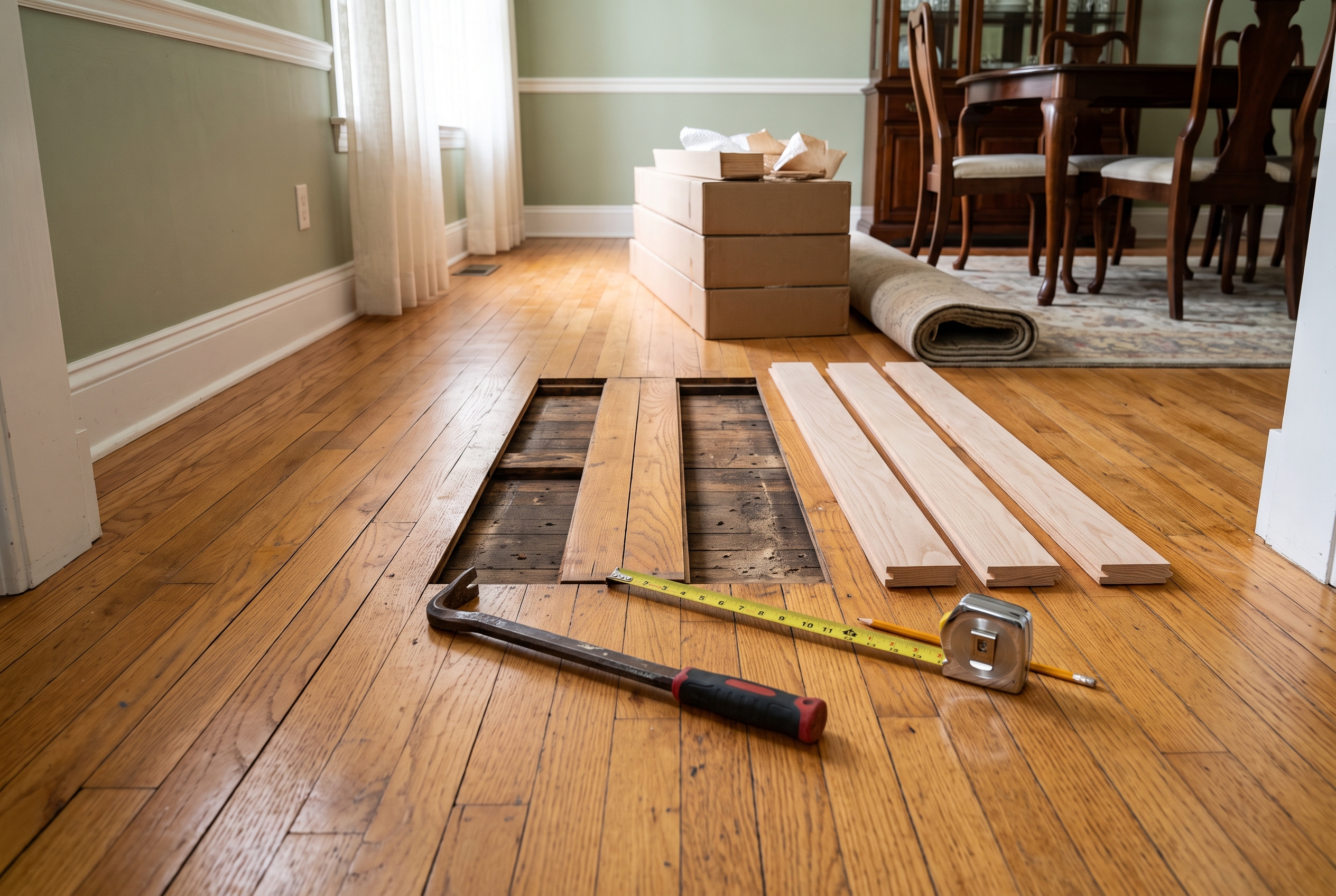
Most damage to a hardwood or laminate floor can be repaired by replacing only the boards or planks that are hurt. A repair makes sense when the damage is limited to one area, the cause has been fixed, and matching material can be found. When the damage runs across the room, keeps coming back, or can no longer be matched or blended, a new floor is usually the better use of your money. Flooring repairs are one of our services across Westchester County, and this is how we sort the damage.
Hardwood with a few bad boards. Cracked boards, deep gouges, black pet or water stains and boards that cupped after a leak are cut out, and new boards are woven in. The area is then sanded and finished so the new wood disappears.
Laminate with a chipped, cracked or swollen plank. Laminate can't be sanded, so a damaged plank is swapped for a new one, and only the smallest chips are worth filling.
Laminate with gaps or peaked seams. The planks themselves are usually fine. The floor has lost its room to move, and freeing the edges and tapping the planks back together fixes it.
Squeaks, soft spots or a floor that flexes. The problem is in the subfloor, and that is where the repair goes.
Nearly every kind of damage has a fix short of a new floor, and this table shows which one.
| Damage | Hardwood fix | Laminate fix |
|---|---|---|
| Scratches in the finish | Touch-up, recoat or refinish | Repair kit, or leave it |
| Deep gouge or chip | Filler, or a new board | Repair putty, or a new plank |
| Black pet or water stain | New boards, then refinish | New plank |
| Cupped or swollen after a leak | Fix leak, dry out, new boards | Fix leak, new planks |
| Gaps or lifted seams | Often seasonal; humidity control | Free the edges, tap planks back |
| Squeaks or soft spots | Subfloor repair | Subfloor repair |
When to Repair the Boards and When to Replace the Floor
Repair the boards when the damage is confined to one area and the rest of the floor is sound. A handful of damaged boards in a room of good hardwood is a repair. So is a single chipped laminate plank, or a row of swollen planks by a dishwasher whose leak has been fixed.
A new floor starts to make more sense in these situations:
- The damage covers much of the room, so a repair would touch most of the boards anyway.
- Water is still getting in, or the subfloor under the damage is soft or rotted.
- The hardwood has been sanded so many times that little wood is left over the tongue.
- The laminate has been discontinued, there are no spare planks, and the repair would sit in plain view.
- You were already planning a new floor, so the repair would only buy time.
Either way, find the cause before anything is replaced. A board that cupped from a slow leak, or a plank that swelled under a dripping ice maker, will fail again if the water keeps coming. Look for leaks, trouble in the subfloor and big humidity swings first.
Surface scratches and small dents are a different job. They live in the finish, and our guide to repairing surface scratches and gouges covers the touch-ups you can do yourself.
How Damaged Hardwood Boards Are Replaced
A damaged hardwood board is cut out where it lies, without lifting the boards around it. The board is sawn down its length and the pieces are pried out, so the tongues and grooves of its neighbors stay intact. The replacement has the bottom lip of its groove trimmed off so it can drop into place. It is then glued, or nailed through its face into small pilot holes, and the nail heads are set and filled.
When several boards in a row are damaged, the repair is woven in. Cutting out a neat square leaves an obvious patch, so the old boards are removed at different lengths instead. That keeps the end joints in neighboring rows staggered, just like the rest of the floor.
New boards look raw until they are sanded and finished with the floor around them. On a stained floor, or one with a few years of age on it, that usually means refinishing the whole room, or at least up to a doorway. Otherwise the repair shows as a lighter patch.
Matching Old Boards in an Older Home
Matching is the hardest part of a hardwood repair, and in older Westchester homes it takes some detective work. Many pre-war and mid-century floors are narrow oak strip, often about 2-1/4 inches wide, in red or white oak. The replacement has to match the species, width and thickness before color even comes up.
Color is harder, because new wood never starts out like old. Wood changes color as it ages, and the finish on an older floor has usually yellowed too, so a new board begins lighter and brighter than its neighbors. A common trick is to borrow boards from inside a closet or under a built-in. Those aged boards go into the visible repair, and the new boards go in the closet, where nobody sees them.
If you are adding onto a floor instead of patching it, our guide to matching new hardwood to an existing floor covers that project.
Pet Stains and Black Water Marks
Dark pet and water stains in hardwood are a chemical change in the wood. Oak is rich in tannins, and tannins turn dark gray or black when they meet water and iron, such as the nails in the floor, or the ammonia in urine. A light gray stain near the surface will often sand out during refinishing. A deep black stain usually runs too far into the board to sand away, so the board gets replaced.
How deep a stain goes usually shows only once sanding starts, so it pays to plan on replacing the darkest boards. Replace them before the floor is refinished, so the new boards are sanded, stained and finished with everything else. If an odor lingers, the urine has reached the subfloor, and that spot gets cleaned and sealed while the boards are up.
Cracked, Cupped or Buckled Boards
A cracked or split board is replaced, because filler won't hold in a board that flexes underfoot. Cupped boards, with edges higher than their centers, mean moisture is coming from underneath. The moisture has to be fixed and the floor dried before anyone decides which boards to replace, and our post on hardwood floor gaps and cupping explains how to tell seasonal movement from real damage.
Buckled boards, lifted off the subfloor after a flood or a burst pipe, are the most serious case. The water comes out first, then the floor is dried with fans, dehumidifiers and a moisture meter and checked for mold. Only then can you tell which boards will flatten and refinish and which have to go. Flood service for water-damaged rooms is part of what we do, so the drying, the subfloor and the boards can be handled as one job.
How Damaged Laminate Planks Are Replaced
A damaged laminate plank is replaced, because laminate's surface is a printed image under a clear wear layer and can't be sanded. The replacement can be made without taking up the whole floor, whether the plank sits by a wall or in the middle of the room.
Near a wall, the simplest method is to remove the baseboard or trim and unclick the rows back to the damaged plank. In the middle of a room, the damaged plank is cut out with a plunge saw. The locking edge is trimmed off the replacement, which is then glued to its neighbors and weighted while the glue sets. Some click systems also have a dedicated tool that lifts out a single plank without cutting.
Chips and scratches too small to justify a new plank can be filled with a color-matched repair kit or putty. Choose the color in daylight, because a filled chip that is a shade off catches the eye more than the chip did.
Swollen Laminate After a Spill or Leak
Swollen laminate has to be replaced once the swelling reaches the core. The core of most laminate is compressed wood fiber, and when water gets into it through a seam, the fibers swell and stay swollen after they dry. Raised, puffy edges along the seams are the sign.
Laminates sold as water-resistant are made to handle spills on the surface, as long as the water is wiped up. A slow leak from a dishwasher or an ice-maker line is another matter, because the water sits under the floor for days. Stop the leak, dry the area, and check the underlayment and subfloor before new planks go down, or the new planks will swell too. Our flood service covers that drying and subfloor work.
Gaps and Peaked Seams in Laminate
Gaps and peaked seams in laminate usually mean the floor can't move the way a floating floor must. Laminate expands and shrinks with the seasons, so it needs open space at every wall, pipe and cabinet, and steady humidity helps. Mohawk calls for at least 3/8 inch of space around its laminate floors and indoor humidity between 35 and 65 percent, and says trim should never be fastened to the floor.
When something pins a floating floor down, such as a kitchen island set on top of it, a screw through a plank or baseboard nailed into the floor, the planks have nowhere to go. They pull apart in winter and push up at the seams in summer. Freeing the floor and tapping the loose planks back together fixes it without a single new plank.
Finding a Match for a Discontinued Floor
A discontinued floor is the most common reason a small repair turns into a bigger decision. Laminate patterns and prefinished hardwood colors change every few years, so a floor put down a decade ago may have no exact match left on the market. These are the ways around it:
- Use spare planks from the original installation. It is why we suggest keeping at least one unopened box after any new floor goes in.
- Borrow planks from a closet or from under a large piece of furniture, and put the closest available product in the hidden spot.
- Stop the new floor at a doorway with a threshold, so the change reads as a new room instead of a patch.
- Replace the floor in the damaged room only, where doorways separate it from the rest of the house.
Bring a spare plank, or a photo of the label on an old carton, to one of our showrooms. With the brand and color name, we can check whether the floor is still made.
What a Floor Repair Visit Looks Like With Us
A floor repair with us starts with a free in-home estimate. We look at the damage, track down the cause if it isn't obvious, check whether matching material exists, and price the repair against the alternatives.
Our listed services include flooring repairs, subfloor repair, flood service and furniture removal, and a repair often uncovers something underneath. Because our installation and repair team handles the subfloor and the boards in the same project, one discovery doesn't stall the job. When a repair needs refinishing to blend, our hardwood floor refinishing service does that part. When a new floor makes more sense, you can see the options in our hardwood and laminate catalogs.
Floor Repair FAQ
How Much Does It Cost to Repair a Hardwood or Laminate Floor?
We price repairs at a free in-home estimate, because the cost depends on how many boards are involved, whether matching material exists, whether the area needs refinishing to blend, and what caused the damage. A single laminate plank near a wall is the simplest job; woven-in hardwood with a room refinish is the biggest.
How Do You Fix a Squeaky Hardwood Floor?
A squeaky floor is fixed in the subfloor, by securing loose subfloor panels and boards to the framing. Squeaks come from boards or subfloor panels rubbing against each other or against loose fasteners, so replacing the top boards rarely stops them. Subfloor repair is one of our services.
Can Engineered Hardwood Be Repaired?
Yes, engineered hardwood can be repaired by replacing damaged boards, much like solid wood. Glued-down and nailed engineered floors are cut out and woven in, and click-together engineered floors are replaced the way laminate is. Sanding is limited by the real-wood top layer: a standard layer about 1/16 inch thick can be refinished only once or twice.
Can I Replace a Laminate Plank Myself?
Yes, if the damaged plank is close to a wall and you are comfortable removing trim and unclicking rows. A plank in the middle of the room is harder, because it has to be cut out with a plunge saw without nicking the planks around it or the subfloor. If you would rather not risk it, we replace single planks as part of our flooring repairs.
Get Your Floor Looked At
If your floor has a damaged board or plank, take a photo, check the basement or garage for spare boxes, and request a free in-home estimate. We'll tell you whether a repair will do the job, what it takes to make it blend, and what it costs, anywhere in Westchester County.

