

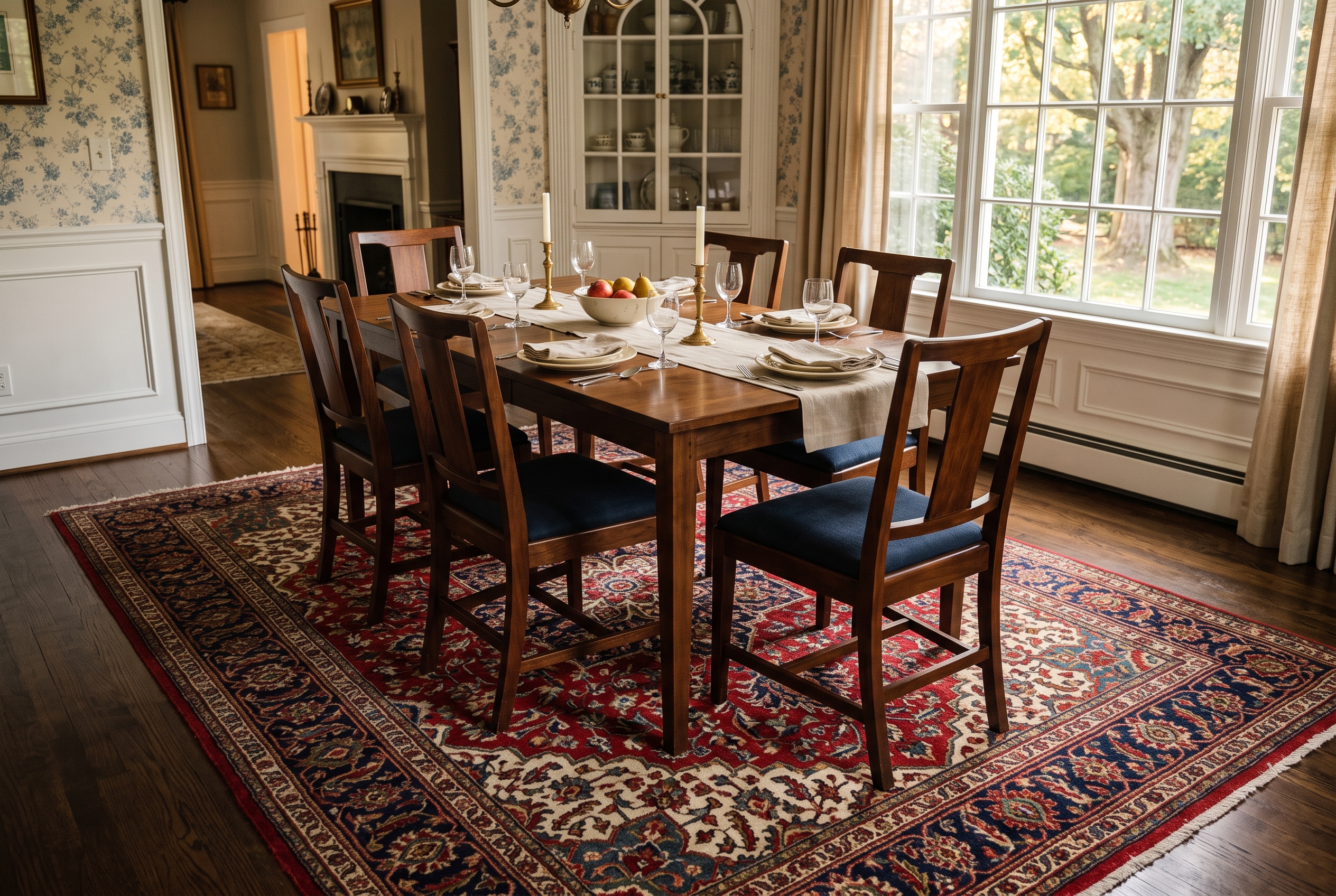
An Oriental rug, in the original sense, is a rug knotted by hand in the weaving belt that runs from Turkey and the Caucasus through Iran and Central Asia to India and China. Today the name also covers the designs themselves, whether the rug was knotted by hand or woven on a power loom. The two can look alike from across a room, but they are made, priced and owned very differently, and our own area rug collection includes many Oriental designs.
A hand-knotted Oriental is a one-of-a-kind piece built to outlast the room. Every knot is tied by hand, a rug takes weeks or months, and small shifts in pattern and color are part of its character. It costs far more, and a fine one can hold its value.
A machine-woven Oriental gives you the look in the size, color and budget you need now. The same classic designs are woven on a power loom in wool or synthetic yarn, with even color and identical rugs from one order to the next.
The quickest way to tell them apart is to turn over a corner. On a hand-knotted rug the pattern shows on the back knot by knot, a little uneven, and the fringe is the rug's own foundation threads.
Hand-knotted wins on character and longevity, and machine-woven on price, speed and consistency, as this comparison shows.
| Feature | Hand-knotted | Machine-woven |
|---|---|---|
| How it's made | Knots tied one at a time | Woven on a power loom |
| Time to make | Weeks to many months | A small fraction of that |
| Back of the rug | Pattern shows, knot by knot | Perfectly regular weave |
| Fringe | The rug's own warp threads | Usually sewn on after weaving |
| Pattern and color | Small shifts and irregularities | Even, repeatable, rug to rug |
| Price and value | Far higher; fine ones hold value | Much lower; bought to use |
What Makes a Rug Oriental
Strictly speaking, a rug is Oriental when it was knotted by hand in one of the traditional rug-weaving regions. The families are named for where they come from. Persian rugs from Iran are the largest group. Turkoman rugs come from Central Asia, along with Afghan and Baluch work, and bold, geometric Caucasian rugs from the region between the Black and Caspian seas. Turkish Anatolian rugs form another group, and rugs from India, Pakistan and China the last.
In a store today, "Oriental" also describes a look. Picture a central medallion or an allover pattern of flowers and vines, framed by a wide border between narrow guard stripes, in deep reds, blues and ivories. Rugs made by machine in those designs are often labeled Oriental-style or Oriental-design. The word on the tag tells you the look, and the construction line tells you how it was made.
These rugs have been prized in the West for centuries. Some that reached Europe were thought too precious for the floor, so they were laid over tables or hung on walls. A few Turkish rug types are still named after two Renaissance painters, Lotto and Holbein, whose pictures show them.
How a Hand-Knotted Oriental Rug Is Made
A hand-knotted rug is built on a loom strung with warp threads, the lengthwise foundation, usually cotton or wool. The weaver ties a short piece of dyed yarn around two warp threads, then the next, and the next. After each row, weft threads are passed across and beaten down tight. When a section is finished, the yarn ends are sheared to an even pile.
Two knots do most of the work. The symmetrical, or Turkish, knot is used mainly in Turkey, the Caucasus and parts of Iran. The asymmetrical, or Persian, knot is used mostly in Iran, India and China. It packs tighter, which is what makes the finest curving detail possible.
Knot count is the measure of fineness. Britannica puts the range at under 20 knots per square inch on some coarse Chinese rugs to more than 2,400 on certain Indian ones, with about 300 typical. At around 8,000 knots a day, an ordinary rug takes a weaver several weeks, and a complex one takes months. A low count isn't a flaw: bold geometric village rugs never needed fine knotting to look right.
Hand dyeing leaves its own mark. Wool dyed in small batches, especially with natural dyes, varies slightly from batch to batch, so bands of a slightly different shade run across the rug. The trade calls it abrash, and on a hand-knotted rug it is a sign of the hand, not a defect.
How Power Looms Weave an Oriental Design
A machine-woven Oriental comes off a power loom that weaves the pile and the backing together, following the design from a pattern control instead of a weaver's chart. Two looms make most of them: the Wilton and the Axminster.
A Wilton loom uses a Jacquard mechanism to bring the right colored yarn to the surface at each point of the pattern. The best Wiltons run to about 120 tufts per square inch. An Axminster loom sets each tuft of color right where the design calls for it, so all of its yarn goes into the pattern. That is how it reproduces the wide color range of an Oriental design. Wool pile is traditional on both, and nylon, polypropylene and blends are common too.
What the loom gives you is consistency. Every rug in a design is the same, so a pair of runners or a matching rug for the next room is easy. The colors are even, the sizes are standard, and the price reflects a fraction of the weaving time.
The Yonkers Mills Behind Machine-Woven Orientals
The machine-woven Oriental has a Yonkers accent. Alexander Smith & Sons opened its carpet mills in Yonkers in 1865 and worked with the inventor Halcyon Skinner on a power loom called the Moquette. The Axminster rugs it wove came closest to matching hand-knotted Oriental rugs, and the company built both the looms and the rugs.
In the early 20th century the Yonkers plant was the largest carpet factory in the world, and just after World War II it employed 7,000 people. The street names near Nepperhan Avenue still carry the history, Axminster Street and Moquette Row among them. It is our history too: our owner's great-great-uncles worked in those mills, a story we tell on our About page.
How to Tell Hand-Knotted From Machine-Woven
You can tell a hand-knotted Oriental from a machine-woven one in a minute, without a label, by checking four things in this order.
- Turn over a corner. A hand-knotted rug shows its pattern on the back as rows of individual knots, slightly uneven, almost like the front. A machine-woven back is perfectly regular, and on many the pattern looks softer or sits behind the backing threads.
- Look at the fringe. On a hand-knotted rug the fringe is the ends of the warp threads, part of the rug itself. On a machine-woven rug it is usually a strip sewn onto the ends.
- Check the sides. Hand-knotted sides are wrapped by hand in yarn and wander a little. Machine-woven sides are bound or serged in a straight, even line.
- Compare the pattern. On a hand-knotted rug the two halves never quite match, and color shifts in bands. On a machine-woven rug the pattern is mirror-perfect.
A third construction, hand-tufted, sits between the two. Yarn is punched through a backing with a hand tool and held with a latex coat and a fabric back, so the back is covered and the fringe is added. It isn't knotted, even when the design is Oriental. Our post on hand-knotted, hand-tufted and machine-made rugs compares all three.
Price, Value and How Long They Last
A hand-knotted Oriental costs far more than a machine-woven rug of the same size, because you are paying for weeks or months of a weaver's time. A fine one, well kept, can last for generations, and handmade rugs used with care generally become more valuable. Most new hand-knotted rugs are still bought to live with rather than as investments, and what they are worth later depends on quality, age and condition.
A machine-woven Oriental is bought to use, the way you buy a sofa. It isn't an investment and isn't meant to be. What it gives you is the design you want at a price that makes sense for a busy room, and a quality wool or well-made synthetic rug gives years of everyday service.
What the Design Names Mean
Most Oriental design names are place names. On a machine-woven rug they describe the pattern family, not where the rug was made. Many come from Persian weaving towns:
- Kashan, long Iran's silk center, known for silk medallion rugs.
- Kerman, home of the so-called vase carpets, with flowering lattices.
- Isfahan, source of many of the finest gold-threaded carpets of the 1600s.
- Tabriz, one of the likely homes of the court workshop that turned book illumination into carpet design.
- Sarouk, from the Arak district, known for its medallion pattern.
- Ferahan, the source of the herati pattern, a dense allover design of small flowers and leaves.
The Isfahan carpets have a good story. When they were shown at the Paris exposition of 1878, nothing like them had yet been found in Persia, so they were taken for Polish work and are still called Polonaise carpets.
Caucasian names such as Kuba and Shirvan point to bold, geometric designs instead. When you see one of these names on a tag, read it the way you would read "Colonial" on a chair: it tells you the style.
Choosing an Oriental Rug for Your Room
Choose by the room's traffic and by how long you plan to keep the rug. A living room or formal dining room that will keep the same rug for decades is where a hand-knotted piece earns its price. An entry, a family room, a hallway that needs matching runners, or a room you may redo in five years suits a machine-woven Oriental.
Busy Oriental patterns hide everyday soil and small spots better than solid colors, which is why they have long been a favorite in dining rooms and entries. Wool, in either construction, springs back from footsteps and resists soiling. Keep any rug with natural dyes out of hard afternoon sun, or turn it regularly, so it fades evenly.
You can browse the Oriental and traditional designs we carry, and filter them by fiber, in our area rug catalog.
Caring for an Oriental Rug
An Oriental rug of either kind needs the same basics: regular vacuuming, a good pad, turning, and quick work on spills.
- Vacuum often, but keep the fringe out of the brush roll and use suction only near the ends.
- Turn the rug 180 degrees every few months to once a year, so light and traffic reach every part evenly.
- Use a pad. It keeps the rug from creeping, cushions the pile and protects the floor.
- Blot spills right away, working from the outside in, and dry water spills fast.
A hand-knotted rug should be washed every two to five years, depending on traffic, by specialists who first beat the dust out of the foundation and then wash it by hand. It shouldn't go to a general carpet cleaner. A machine-woven rug follows the care label for its fiber. For more, see how to vacuum area rugs without pulling fibers and our area rug care guide, which covers spills, storage and repairs.
Oriental Rug FAQ
Is a Persian Rug the Same as an Oriental Rug?
No, not every Oriental is Persian. A Persian rug is one kind of Oriental: a rug knotted in Iran. U.S. sanctions have barred bringing Iranian-made rugs into the country for sale since 2010, apart from a window from 2016 to 2018. So a new rug sold here as "Persian" is almost always a Persian design woven somewhere else, by hand or by machine.
Are Oriental Rugs a Good Choice With Pets and Kids?
Yes, Oriental rugs are one of the more forgiving choices for pets and kids, because busy patterns hide spots and wool shrugs off wear. A machine-woven Oriental in a busy pattern is the easy pick for a family room. Save a fine hand-knotted piece for a room the dog doesn't nap in, and keep claws trimmed so they don't snag the pile or the fringe.
Do Oriental Rugs Work in a Modern Room?
Yes, an Oriental rug often looks best against clean-lined furniture, where its pattern and color do the decorating. Faded or low-contrast designs sit comfortably in a modern room, and a bold red or blue Oriental can anchor an otherwise plain one.
Find Your Oriental Rug
An Oriental rug is a long-term decision, and it is easier with the rug in front of you. Visit one of our three showrooms in Yonkers, Mohegan Lake or Mount Kisco to see the designs we carry. If your room is an odd size, we also make custom area rugs, cut and bound to fit. Or request a free in-home estimate, and our shop-at-home service can bring samples to you so you can judge them in your own room and light.

