

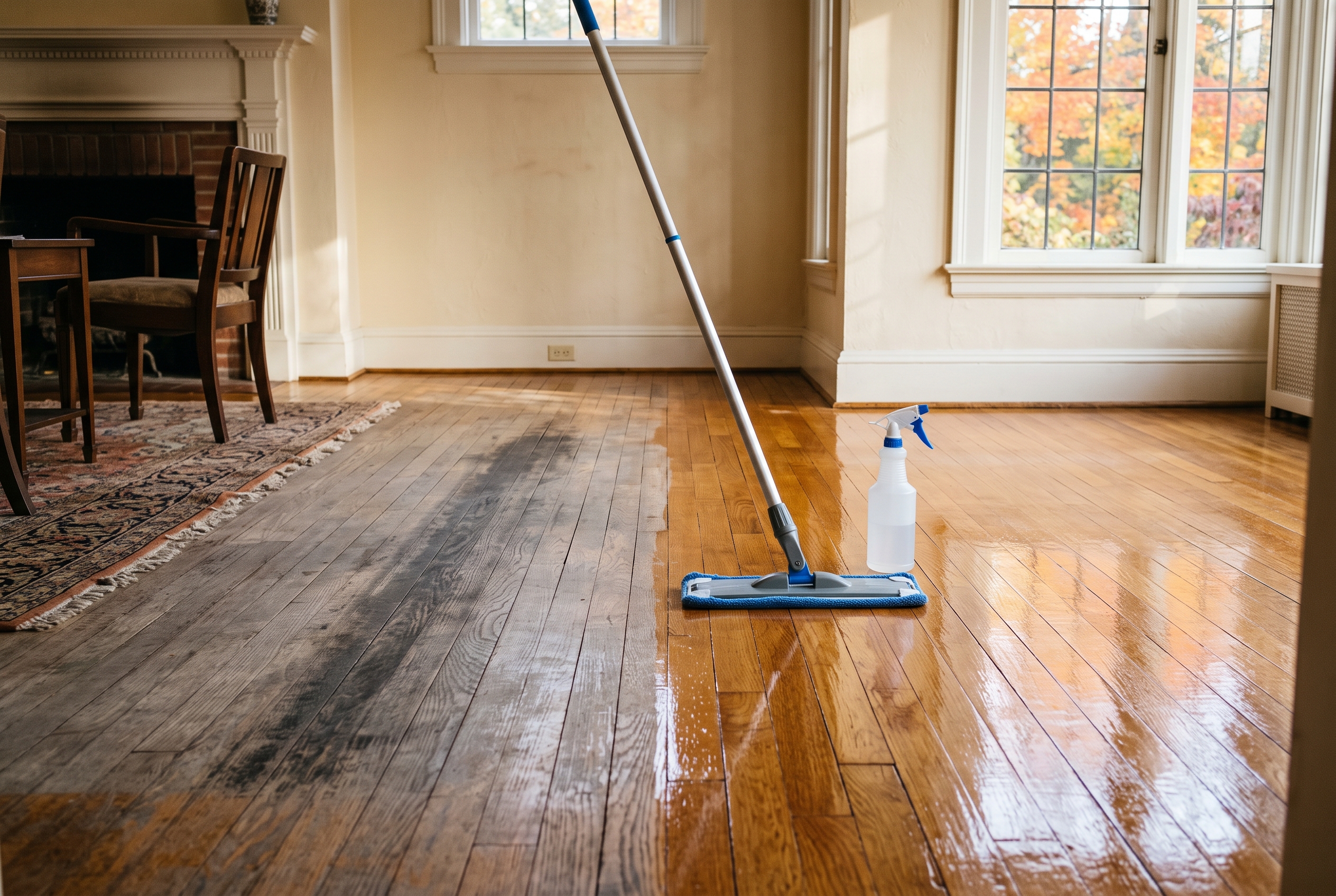
A deep clean is enough when the finish on your hardwood is still intact and the dullness is dirt or old product sitting on it. If water soaks into the wood where you walk most, or you can see gray or bare wood, the finish is gone in those spots and no cleaner will put it back. The floor needs new finish: a recoat if the wear is shallow, sanding and refinishing if it has reached the wood.
Dull or streaky, and water still beads. The finish is doing its job. A careful deep clean with a cleaner made for your finish usually brings the shine back in an afternoon.
Flat traffic lanes, and water darkens the wood slowly. The finish is thin but not gone. Deep clean it, and if the lanes still look flat, a recoat is next: the old finish is scuffed with a fine pad and a fresh coat goes on, with no sanding to bare wood.
Gray wood, dark stains, scratches that catch a fingernail. The damage is in the wood itself. That takes sanding and refinishing, and scrubbing harder only packs dirt into the open grain.
Waxed and oil-finished floors play by their own rules. The water-based cleaners that suit a polyurethane floor can leave white marks in wax and dry out an oil finish, so find out what you have before you clean.
Most dull floors only need cleaning, and this table sorts out the signs that say otherwise.
| What you see | What it usually means | What fixes it |
|---|---|---|
| Haze, streaks or a sticky feel | Residue from cleaners or polish | Deep clean with the right cleaner |
| Dull all over, water beads | Dirt on a sound finish | Deep clean |
| Flat lanes, water darkens slowly | Finish worn thin | Clean, then recoat |
| Gray lanes, water soaks in fast | Finish worn through to wood | Sand and refinish |
| White marks where water sat | Probably a wax finish | Wax-safe cleaning, no water |
| Dark or black stains | Water or pet damage in the wood | Sanding, or new boards if deep |
How to Tell Dirt From Worn Finish
To tell whether hardwood needs cleaning or refinishing, pour a tablespoon or two of water on the most worn spot you have. That is usually in front of the kitchen sink, at the back door or along the path to the couch. Then watch what the water does.
- It beads up and wipes away without a mark. The finish is intact, the problem is on the surface, and cleaning will fix it.
- The wood darkens a little after a few minutes. The finish is partly worn. Clean it and keep an eye on that spot, because a recoat is coming.
- The water sinks in right away and leaves a dark spot. The finish is worn through. That area needs new finish, and if the wood has turned gray, it needs sanding.
Wipe the water up once you have your answer. Then try a spot nobody walks on, such as under a bed. If the protected spot beads and the traffic lane soaks, you are looking at wear, not dirt, and comparing the two shows you how far the wear has spread.
If the whole floor is dull, even under the furniture, and water beads everywhere, the cause is almost always residue or dirt. Clean a two-foot square with a cleaner made for your finish and a barely damp microfiber pad. If that square comes up brighter than the floor around it, the rest of the room will too.
Know Your Finish Before You Deep Clean
Before you deep clean hardwood, find out whether it has a surface finish like polyurethane, a wax finish or an oil finish. The right cleaner for one can damage another. Most floors finished in recent decades have a surface finish, and so do most prefinished floors.
Older floors are the question mark. For generations, wood floors were finished with shellac and wax. Polyurethane only reached the market in the late 1950s, and waxed floors were still being sold into the 1970s. So a pre-war apartment in Yonkers or a mid-century house in Yorktown Heights may still have wax on it, sometimes on top of a newer finish.
Four quick checks tell you what you have.
- Run your hand across the boards. A smooth, slightly slick film means a surface finish. If you can feel the grain of the wood, oil or wax is more likely.
- Leave a few drops of water in a low-traffic spot for about ten minutes. White marks under the drops point to wax.
- Rub a hidden spot with a clean white rag dampened with mineral spirits. A yellow or brown smudge on the rag means there is wax on the floor.
- In a closet or under an appliance, scrape very lightly with a razor blade. If a thin clear film lifts, the floor has a surface finish.
If the checks disagree, or you would rather not scrape an old floor, we are glad to take a look during a free in-home estimate.
How to Deep Clean a Polyurethane Hardwood Floor
Deep cleaning a polyurethane or other sealed hardwood floor comes down to two jobs. First you get the grit out of the seams. Then you lift the film of dirt and old product off the finish, using a cleaner made for it and as little water as you can. Plan on an hour or two per room.
- Clear the room, or at least roll up the rugs and lift the chairs, so you clean the whole floor instead of around things.
- Vacuum on the bare-floor setting with the brush roll off. Run a crevice tool along the board seams and the edges of the room, because grit left behind turns a mop into sandpaper.
- Use a pH-neutral cleaner made for wood floor finishes. On a prefinished floor, the cleaner its maker recommends is the safest choice; on a floor finished on site, pick one labeled for polyurethane or sealed wood.
- Spray the cleaner onto a small section or onto a microfiber pad, never pour it, and wipe with the grain. The pad should be damp, not wet.
- Switch to a clean pad as soon as yours looks gray. A dirty pad just moves the film around, which is why so many floors look streaky after mopping.
- Work a few feet at a time, and make sure each section dries within a minute or two.
- Rub scuffs and sticky spots with a little cleaner on a soft cloth.
- Put felt pads back under the furniture legs before everything goes back in place.
For the everyday routine between deep cleans, our hardwood floor care guide covers the tools and the schedule. If the vacuum itself seems to be leaving marks, here is how to vacuum hardwood without scratching it.
If Your Floor Is Waxed
A waxed floor can stay waxed; it just needs its own care. Clean it with solvent-based products made for wax finishes and never with water-based cleaners. Sweep and vacuum as usual, then work in a solvent-based wax cleaner or buffing paste and buff it out. Add a thin coat of wax only where it has worn.
If a waxed floor looks dull, try buffing before you reach for more wax, because wax builds up under furniture and in corners, where nobody walks it off. White water spots on wax usually come out with a little mineral spirits on fine steel wool or a synthetic pad, rubbed gently in circles. Re-wax and buff the spot afterward.
Moving a waxed floor to polyurethane is a full sanding job, and it takes extra care at the seams and in the soft grain, where old wax hides and can keep new finish from bonding.
If Your Floor Has an Oil Finish
An oil-finished floor is cleaned only with a cleaner made for oiled wood. The oiled floors we carry from DuChateau come with their own care line, and the maker warns that products made for sealed floors can dry out and damage an oil finish. Oiled floors are renewed with maintenance oil rather than a recoat. The signs it is time are water that no longer beads, uneven sheen and color that has gone flat, and a worn traffic lane can be re-oiled without redoing the whole room.
What a Professional Deep Clean Can and Cannot Fix
A professional deep clean removes what sits on top of the finish. Machine scrubbing and extraction lift ground-in dirt, grease and old product residue, and they pull grit out of the bevels, gaps and open knots a mop never reaches. For a dull floor in a busy house, that is often all it needs.
What no cleaning can do is replace finish that has worn away. Traffic lanes where water soaks in, gray boards and stains in the wood stay as they are, and scrubbing bare wood can make it look worse because the water goes straight into the grain. Cleaning won't change the color or sheen either. Scratches that reach the wood need spot repair or sanding; for small ones, our guide to repairing surface scratches and gouges covers what you can do yourself.
Cleaners That Dull a Floor or Stop a Recoat From Sticking
The wrong cleaner hurts a hardwood floor twice. It dulls the finish now, and it can leave a film that the next coat of finish will not bond to. The second problem is the expensive one, because a floor that could have been renewed with a recoat may have to be sanded to bare wood instead.
- Steam mops push hot vapor into the seams and the wood fibers. The National Wood Flooring Association says steam and wet mops damage both the finish and the wood over time.
- Vinegar is acidic, so repeated use wears down the finish, and it leaves a sticky film that attracts dirt.
- Oil soaps leave oil behind. That dulls the finish, makes the floor slippery and gets in the way of a recoat later.
- Polishes, "restorers" and wax don't belong on a polyurethane floor. They build a slippery film that dulls quickly, and new finish won't stick to it until it is stripped or sanded off.
- Ammonia, bleach, all-purpose sprays and tile or vinyl cleaners are too harsh for a wood finish, and several leave residue.
Bruce hardwood, which we carry, comes with a do-not-use list of its own: ammonia, wax-based cleaners, polishes, oil soaps and vinegar are all on it, and some of them can strip the finish outright. Factory finishes have one more reason to stay clear of wax and oils. Many are so hard-wearing that they already need a special bonding step before a recoat, and a layer of polish on top makes that job harder.
If your floor has turned hazy or cloudy after years of one of these, stop using it and switch to a cleaner made for your finish. Some haze lifts after a few cleanings.
Can a floor like that still be recoated? Often, yes: the residue is cleaned off and a small test patch of finish is checked for grip before the whole room is done. If the product has worked into the finish and the test patch won't bond, sanding is the way forward. Tell us what you have been using when we come to look, because it decides which of those it will be.
When a Recoat Is the Better Fix
A recoat is the better fix when your floor has lost its luster but the finish hasn't worn through to the wood. The floor is cleaned, the old finish is scuffed with a fine pad or screen so the new coat can grip, and a fresh coat goes on. Nothing is sanded to bare wood, so it costs far less than refinishing and the room is back in use sooner.
A recoat covers wear; it doesn't remove damage. Dents, gouges and deep scratches stay in the floor and can look more obvious under fresh finish. Lanes worn down to bare wood take the new coat differently from the rest of the floor and stay visible.
Boards that have cupped from water stay cupped after a recoat, too. And the floor must be free of wax, polish and oily cleaners, or the new coat won't bond.
When Your Floor Needs Sanding and Refinishing
Your hardwood needs sanding and refinishing when the finish has worn through, when stains or scratches have reached the wood, or when you want a new color or sheen. Refinishing sands off the old finish and the damaged surface of the wood, then adds stain if you want it and fresh coats of finish. It is the only one of the three fixes that removes damage instead of covering it.
How many times a floor can be refinished depends on how much wood is left over the tongue. Bruce rates its 3/4-inch solid planks for four to six sandings, and a standard engineered plank, with a real-wood top layer about 1/16 inch thick, for once or twice. If you don't know whether your floor is solid or engineered, or how many times it has been sanded, that is one of the first things we check.
Some damage belongs to the boards rather than the finish. Lighter gray marks and surface stains often sand out, but deep black stains from old water or pet accidents, and cracked, split or badly cupped boards, usually mean replacing those boards before the floor is sanded. Cupping caused by moisture under the floor needs that moisture fixed first, and our post on hardwood floor gaps and cupping explains how to tell normal seasonal movement from a real problem.
This is the work our hardwood floor refinishing team does across Westchester. Flooring repairs and furniture removal are part of our services too, so the same team can assess the floor, replace the boards that need it and refinish the room. If the floor turns out to be past saving, our guide to deciding whether to refinish or replace walks through that choice, and our hardwood catalog shows what could go down instead.
Hardwood Floor Cleaning FAQ
How Often Should Hardwood Floors Be Deep Cleaned?
Most hardwood floors need a deep clean a couple of times a year, as long as they are swept or vacuumed several times a week and cleaned with a wood floor cleaner about once a month. Kitchens, entries and homes with pets may need it more often. Around here, spring is the natural time, once the salt and grit of winter are done.
Can You Deep Clean Engineered Hardwood the Same Way?
Yes, engineered hardwood with a factory finish is deep cleaned the same way as a sealed solid floor, with a cleaner made for the finish and a barely damp pad. Because a standard engineered floor can only be sanded once or twice, it also pays to recoat it before the wear reaches the wood.
How Do You Get Salt Stains Off Hardwood Floors?
Wipe salt stains with a cloth barely dampened with warm water, dry the spot right away, then clean it with your wood floor cleaner. Do it as soon as you see the white film by the door, because slush and ice melt left to sit keep working on the finish. A washable mat inside each entry catches most of it during a Westchester winter.
How Much Does Hardwood Floor Refinishing Cost?
We price refinishing at a free in-home estimate, because the cost depends on the square footage, the condition of the wood, any boards that need replacing, stairs, a change of stain color and how much furniture has to move. Cleaning costs the least and sanding the most, with a recoat in between.
Have Us Look at Your Floor
Do the water-drop test in your worst spot and your best one, and you'll know most of what we would check first. If the answer points to a recoat or refinishing, or you're still not sure, request a free in-home estimate. We'll come out anywhere in Westchester County, tell you whether cleaning will do the job, and price the work if it won't.

